
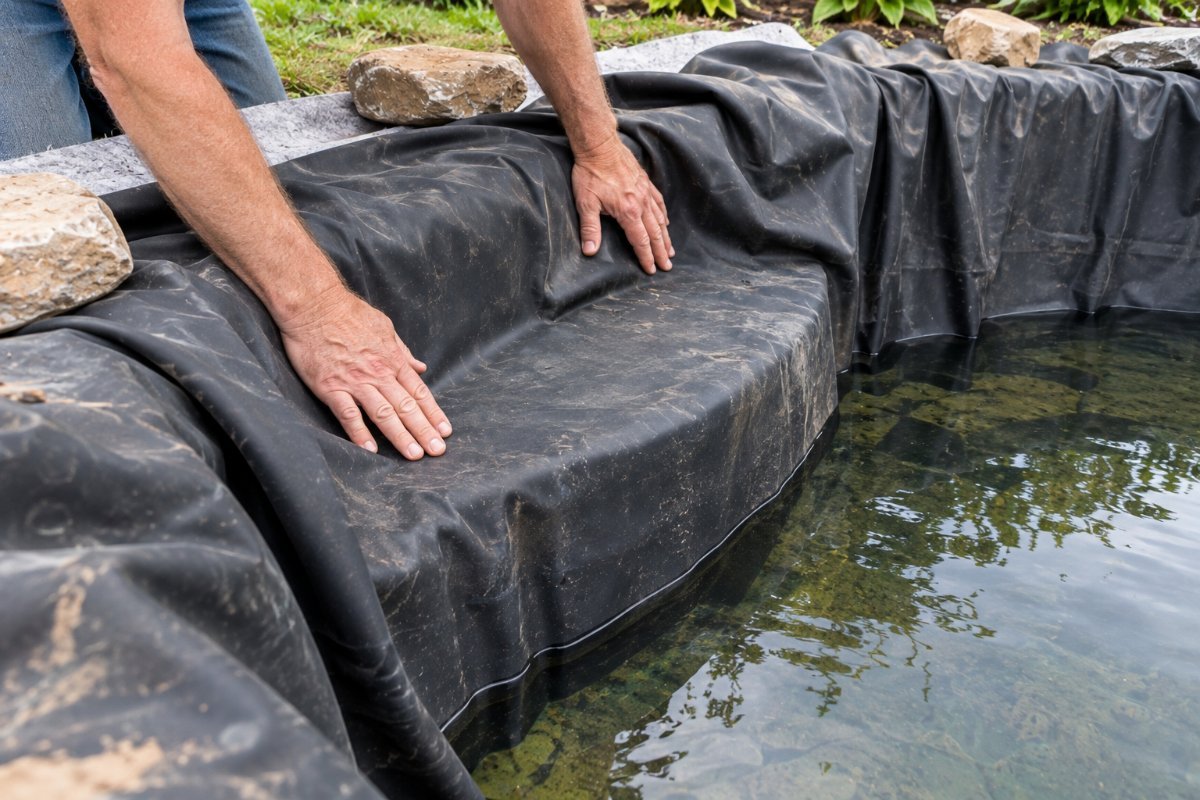
For most backyard ponds, an EPDM pond liner is the best choice of the three. EPDM is a synthetic rubber that stays flexible in the cold, holds up well in sunlight, and folds neatly into curves and shelves. HDPE is a stiff plastic that suits large ponds built by professionals. PVC is cheap and easy to fold, but it has the shortest lifespan in sunlight.
This guide compares the three materials side by side. It covers flexibility, strength, lifespan, cost, and fish safety, and it explains when HDPE or PVC is the better pick. If you are still planning your pond, start with our main pond liner guide, which covers sizing and installation.
Table of Contents
The short answer
- Best for most backyard ponds: a 45 mil EPDM pond liner. It is flexible, easy to patch, and lasts about 20 to 30 years.
- Best for large ponds built by a pro: HDPE. It is tough and resists sunlight, but it is stiff, and its seams must be heat welded.
- Best for small budget features: PVC. It is cheap, light, and easy to fold, but it lasts about 7 to 15 years and must be fully covered from the sun.
- Most important rule: buy a liner sold for ponds and labeled fish-safe. Never use roofing rubber.
What EPDM, HDPE, and PVC are
EPDM stands for ethylene propylene diene monomer. It is a synthetic rubber and the most common liner for backyard ponds. It comes in almost every pond kit sold. An EPDM pond liner feels like a thick, heavy sheet of inner tube rubber.
HDPE stands for high-density polyethylene. It is a stiff, smooth plastic sheet. Crews weld large panels together on site to line farm ponds, reservoirs, and landfills.
PVC stands for polyvinyl chloride. It is a soft, light plastic sheet. Chemicals called plasticizers make it bendable, which is what lets it fold so easily.
All three are measured in mil. One mil is one thousandth of an inch, so it is not the same as a millimeter. A 45 mil liner is about 1.14 millimeters thick.
EPDM pond liner vs HDPE vs PVC at a glance
| Feature | EPDM rubber | HDPE | PVC |
|---|---|---|---|
| Usual thickness for ponds | 45 mil | 30 mil or more | 20 to 30 mil |
| Flexibility | Very flexible, stretches | Stiff | Very flexible, does not stretch much |
| In cold weather | Stays flexible | Stiff | Turns stiff |
| In sunlight | Good | Good | Poor, must be covered |
| Puncture resistance | Low, needs underlayment | Good | Fair |
| How seams are joined | Seam tape | Heat welding | Glue or heat welding, easy to patch |
| Typical lifespan | 20 to 30 years | 20 to 25 years | 7 to 15 years |
| Cost per square foot | $0.70 to $2.30 | $0.40 to $1.30 | $0.50 to $1.50 |
| Best for | Most backyard ponds, waterfalls, and streams | Large or commercial ponds | Small, short-term, or budget water features |
Why an EPDM pond liner suits most backyard ponds
The main reason is flexibility. POND Trade Magazine describes EPDM as having very high elongation, meaning it can stretch far before it tears. That lets an EPDM pond liner settle into curves, steps, and planting shelves (shallow ledges inside the pond edge), and move a little without splitting as the soil shifts.
It also copes with weather. Elevate (formerly Firestone), which makes PondGard EPDM, says its liner stays flexible down to about minus 49 degrees F. EPDM resists sunlight and ozone well, so a strip of liner left showing at the edge will not break down quickly.
Repairs are simple. Seams and patches use special seam tape, and the maker of PondGard says you don’t need any special tools. You can fix small holes with a patch kit made for EPDM.
EPDM has two weak points:
- Weight. A 45 mil EPDM pond liner weighs about 0.28 pounds per square foot. A 16-by-13-foot liner weighs close to 60 pounds, so plan on a helper.
- Punctures. EPDM rates low for puncture strength. A sharp stone or root under the liner can pierce it, so it always needs an underlayment, a thick fabric layer laid between the soil and the liner.
When HDPE makes sense
HDPE is a strong, long-lasting liner. It lasts about 20 to 25 years, according to Angi, and resists sunlight well. The problem for a backyard pond is that it is stiff.
A stiff sheet does not fold neatly. On a small pond with curves and shelves, HDPE forms hard creases that are difficult to hide. Plastic liners also expand and contract slightly as the temperature changes during the day. On a stiff sheet, that movement shows up as waves and wrinkles that do not lie flat.

Seams are the other issue. You can’t join HDPE with tape. The panels must be heat welded with special equipment, and Robert Koerner, founder of the Geosynthetic Institute, noted in Geosynthetics Magazine that field welding very thin HDPE is unreliable. For these reasons, crews mostly use HDPE on large farm and commercial ponds.
HDPE can work at home in one case. If you are building a simple, formal pond with straight sides and the supplier sends the liner already welded to size, the stiffness matters less.
When PVC makes sense
PVC is light, cheap, and easy to fold, so it is simple to work with on a small pond. It is a fair choice for a patio water feature, a short-term pond, or a tight budget.
Its weakness is sunlight. PVC has a very short life when it is left in the sun. PVC also turns stiff in hard cold, so it is best installed on a mild day. The U.S. Department of Agriculture’s Natural Resources Conservation Service, the federal agency that writes standards for farm ponds, requires PVC liners to be covered by at least 12 inches of soil.

There is also a fish question. The NRCS standard does not recommend PVC for ponds used to raise fish, because stabilizers in the plastic can leach out and may harm fish. Fish-safe PVC liners are sold, so if you keep fish, buy one labeled as such.
If you choose PVC, buy the thicker 30 mil grade and cover any part that will face the sun.
Other liners you will see
When you shop for liners, you will also see these materials:
- RPE (reinforced polyethylene): a thin polyethylene sheet with a woven fabric layer inside. It is stronger than both EPDM and PVC, and it weighs about half as much as EPDM. It is stiffer to fold, and its seams must be heat welded.
- LLDPE (linear low-density polyethylene): a softer, more flexible cousin of HDPE. It is usually sold in 20 or 30 mil thicknesses, and its seams are also welded.
- Butyl rubber: a rubber liner common in UK garden ponds, usually sold 0.75 millimeters thick. The Conservation Volunteers, a UK charity, calls it the most durable flexible liner. It costs more than PVC or polyethylene.
For a full look at RPE and rigid preformed ponds, see the types section of our pond liner guide.
What thickness to buy
The NRCS sets minimum thicknesses for liners that hold clean water. These are written for farm ponds, but they are a useful floor for a backyard pond too:
- EPDM: 45 mil
- HDPE: 30 mil
- PVC: 30 mil
- LLDPE: 30 mil
For a backyard pond, 45 mil is the standard EPDM liner thickness. You will also see 60 mil EPDM. It is tougher but heavier and harder to fold, so most homeowners do not need it.
Is an EPDM pond liner safe for fish?
Yes, if it is made for ponds. EPDM is also sold as roofing rubber, which often costs less. Do not use it. A horticulturist at the University of Georgia warns that roofing material and swimming pool liners can contain chemicals that kill fish.
A fish-safe EPDM pond liner is made without those additives. Look for the words “fish safe” or “pond liner” printed on the product and on the sheet itself. For example, PondGard is printed with a fish-safe marking along the membrane.
What each liner costs
Here is what the liner material alone costs for a pond that needs a 16-by-13-foot liner, which is 208 square feet. The prices per square foot are from Angi:
- EPDM: about $146 to $478
- PVC: about $104 to $312
- HDPE: about $83 to $270
PVC and HDPE look cheaper, but the gap is smaller than it seems. PVC may need replacing once or twice over the life of one EPDM pond liner, and you pay to drain and reline each time. HDPE often needs a professional to weld its seams, which adds to the cost.
To work out the liner size for your own pond, use the pond calculator on our homepage.
For specific liners and current prices, see our picks for the best pond liner for a small backyard pond.
How to repair each liner
Every liner can get a hole, so it helps to know how hard each one is to fix.
- EPDM: the easiest to fix yourself. Clean and dry the area, apply primer, and press on an EPDM patch or seam tape. EPDM patch kits usually include the patch and primer you need.
- PVC: also easy. PVC patch kits include a PVC patch and matching glue. Old PVC that has turned brittle in the sun is harder to patch because the area around the hole may crack.
- HDPE: hard to fix at home. A proper repair is a welded patch, which requires a hot-air or extrusion welder. Most owners call the installer.

Before you patch, find the leak. Let the water drop until it stops falling, because the hole is usually somewhere along that line. Our pond liner guide explains how to check the edges first.
Which liner for waterfalls and streams
Waterfalls and streams have many small turns, steps, and rocks. The liner has to bend around all of them without leaving gaps where water can escape.
EPDM is the usual choice here because it stretches and molds around rocks. HDPE is too stiff to follow a stream bed, and its creases can lift above the water line and leak. PVC can work on a short stream, but any part that sunlight reaches will wear out first.
Whatever liner you use, keep the stream edges higher than the water. A common cause of waterfall leaks is an edge that has sunk below the water line, not a hole in the liner.
How to choose
Use these simple rules:
- Choose EPDM for almost any backyard pond, waterfall, or stream, and for any pond with fish.
- Choose HDPE for a large pond a contractor will install, or a formal, straight-sided pond with a liner the supplier welds to size.
- Choose PVC for a small or short-term water feature on a budget, as long as you can keep it fully covered.
- Choose RPE if you need a very large liner that is lighter to handle than EPDM.
Whichever material you pick, lay it over an underlayment and cover the edges with rock or soil. Both steps add years to any liner.
EPDM pond liner FAQ
Which pond liner is better, EPDM or PVC?
EPDM is better for most ponds. It lasts about 20 to 30 years, compared with about 7 to 15 years for PVC, according to Angi. It also holds up much better in sunlight. PVC costs less and works well for small, short-term water features you can keep fully covered.
What is the strongest pond liner?
POND Trade Magazine says RPE (reinforced polyethylene) is stronger than both EPDM and PVC. HDPE is also very tough. EPDM is weaker against punctures, so it should always sit on an underlayment.
Is an EPDM pond liner safe for fish?
Yes, if it is sold as a pond liner and labeled fish-safe. Do not use EPDM roofing rubber, which can contain chemicals that harm fish.
How long does an EPDM pond liner last?
About 20 to 30 years, according to Angi. It lasts longest when it sits on an underlayment, and its edges are covered with rock or soil.
Is HDPE a good pond liner for a backyard pond?
Usually not. HDPE is tough and long-lasting, but it is stiff, it wrinkles as temperatures change, and its seams must be heat-welded. It suits large ponds installed by professionals better than small backyard ponds.
Bottom line
For a backyard pond, buy a 45 mil EPDM pond liner that is labeled fish-safe. It costs more than PVC or HDPE, but it is easier to install, simple to repair, and lasts 20 years or more. Choose HDPE only for a large pond built by a pro, and PVC only for a small feature you can keep out of the sun.