
A healthy pond needs four kinds of plants, and each one has its own place. Water lilies grow from pots on the deep floor. Marginal plants sit on the shallow shelves around the edge. Floating plants drift on top, and oxygenators grow underwater. Together they shade the water, use up the nutrients algae feed on, and give fish cover. Aim for leaves to cover about half to two-thirds of the water’s surface.
Below is a planting chart for common pond plants, with how deep each one goes and where it grows well, drawn mostly from university extension services and botanical gardens. Next are the plants to avoid, how many to buy, and how to plant them.
How Plants Keep a Pond in Balance
Algae needs two things: sunlight and nutrients. Plants take away both. Lily pads and floating leaves shade the water, and roots absorb nutrients from fish waste and rotting leaves before algae can use them. Too few plants is one reason ponds turn green.
How much cover is enough? Extension services suggest leaves cover about 50 to 70 percent of the surface. Britain’s Royal Horticultural Society suggests about half. Either way, leave some open water so you can see the fish. Small ponds and ponds in full sun need more cover.
Pond Plant Planting Chart
Depth means how much water sits over the top of the pot. Hardiness zones are USDA zones, which you can look up by zip code. Where sources differ, we list the figure from a university extension service. Edge plants grow in wet soil beside the water, not in it.
| Plant | Type | Water over the pot | Zones | Native to North America? |
|---|---|---|---|---|
| Hardy water lily | Lily | 6 to 18 inches, by size | Survives where the pond doesn’t freeze solid | Some, like the fragrant water lily |
| Tropical water lily | Lily | 6 to 18 inches, by size | Summer only, except zone 10 and warmer | Mostly no |
| American lotus | Lotus | Up to 24 inches | 4 to 10 | Yes |
| Pickerel rush | Marginal | Up to 12 inches | 3 to 10 | Yes |
| Blue flag iris | Marginal | 2 to 4 inches | 3 to 9 | Yes |
| Lizard’s tail | Marginal | Up to 6 inches | 3 to 9 | Yes |
| Arrowhead | Marginal | Up to 12 inches | 5 to 10 | Yes |
| American sweet flag | Marginal | Up to 9 inches | 1 to 6 | Yes |
| Dwarf cattail | Marginal | 3 to 6 inches | Not given by our sources | No |
| Marsh marigold | Edge | Wet soil at the very edge | 3 to 7 | Yes |
| Cardinal flower | Edge | Moist soil beside the pond | 3 to 9 | Yes |
| Hornwort | Oxygenator | Drop it in, it floats underwater | Grows wild across the US | Yes |
| Elodea (Elodea canadensis) | Oxygenator | In pots on the bottom, underwater | Grows wild across much of North America | Yes |
A few notes on the chart. Lilies come in dwarf, medium, and large sizes, and the bigger the lily, the deeper it likes to sit. Large lilies may need more than 18 inches. Marginals like pickerel rush can spread, so grow them in pots. Hornwort has no roots, so just drop it in.
Plants to Avoid
Some popular pond plants spread so fast that they choke lakes and rivers when they escape. Several are illegal to sell or keep in some states.
- Water hyacinth. Prohibited or regulated in states including Florida, Texas, Arizona, Alabama, South Carolina, and Wisconsin.
- Water lettuce. Prohibited or restricted in states including Florida, Texas, California, Wisconsin, North Carolina, and Connecticut.
- Yellow flag iris. Banned or listed as a noxious weed in Connecticut, Massachusetts, New Hampshire, Montana, Oregon and Washington. Grow the native blue flag iris instead.
- Brazilian elodea (Egeria densa) and hydrilla. Brazilian elodea is sometimes sold as “anacharis” and is a quarantined weed in Washington. Hydrilla is a federal noxious weed. Buy the native Elodea canadensis by its full name.
- Asian lotus and creeping Jenny. You can’t plant Asian lotus in Wisconsin, and creeping Jenny is considered invasive in some states and spreads fast in wet ground.
Rules change and vary by state, so check with your state’s department of agriculture or natural resources before you buy. And never dump pond plants into a creek or lake. Give extras of non-invasive plants to another pond owner. Seal anything else in a plastic bag and put it in the trash.
How Many Plants You Need
Start by finding your pond’s surface area. Multiply the length by the width in feet. A pond 6 feet wide and 8 feet long has 48 square feet of surface.
Lilies and floating leaves: for 50 to 70 percent cover, that pond needs about 24 to 34 square feet of leaves. A medium lily spreads about 2 to 4 feet across, so start with about three medium lilies plus some floating plants.
Oxygenators: plan on about one bunch for every 1 to 2 square feet of surface. For the 48-square-foot pond, that is roughly 24 to 48 bunches. You can plant several bunches together in one pot.
Marginals: there is no set number. Fill the shelves around the edge, leaving room to reach the water.
How to Plant Pond Plants
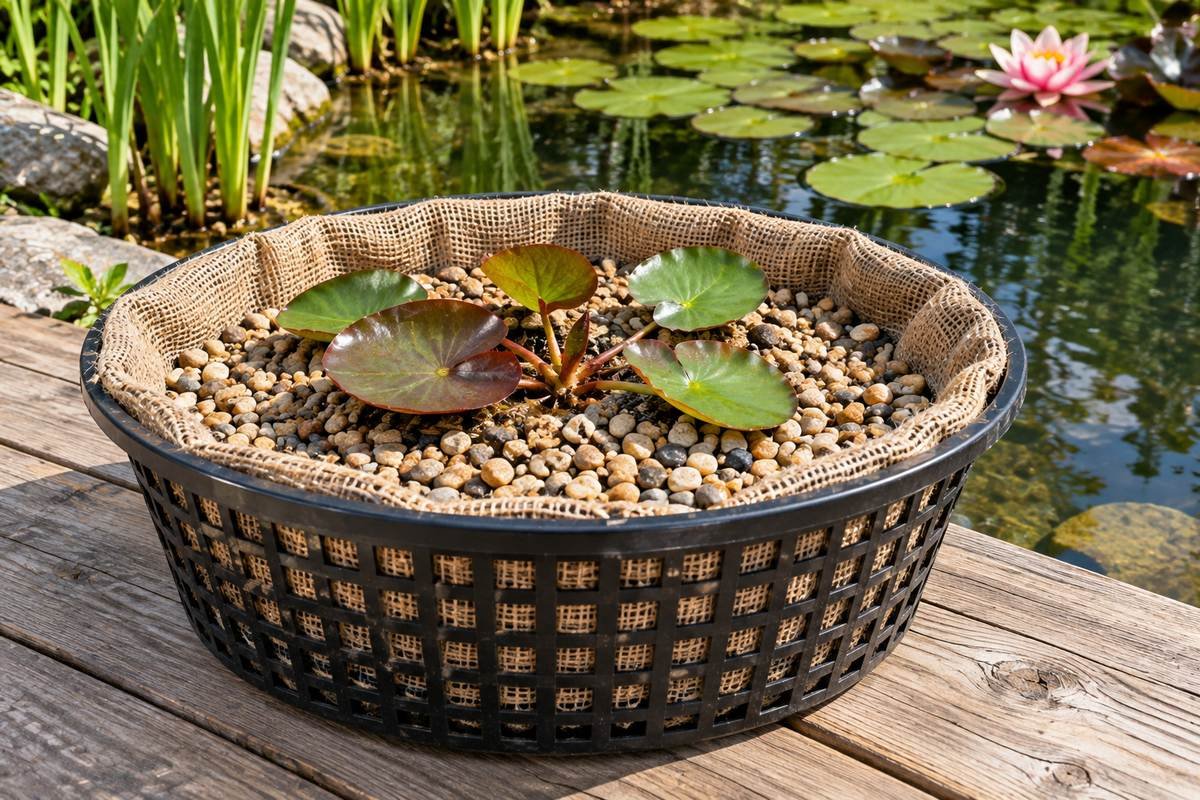
- Pick a wide pot. Use a pond basket or a pot wider than it is tall so it won’t tip over. Line open-mesh baskets with burlap to keep the soil in.
- Use heavy soil. Fill the pot with heavy clay garden soil or bagged aquatic soil, not light potting mix.
- Add fertilizer tablets. Push a pond plant fertilizer tablet down into the soil before planting.
- Plant the crown high. Set the plant so its crown, where the leaves start, sits just above the soil.
- Top with gravel. Cover the soil with about 1 inch of pea gravel. It keeps the soil in place and stops fish from digging.
- Lower lilies in stages. Set a new lily on bricks so it sits about 6 inches under the water. As the leaves reach the surface, remove the bricks one at a time until the pot rests at its full depth.
Plant hardy lilies and most marginals in spring, once the ice is gone. Wait to put out tropical lilies until the water stays at about 70°F.
How to Rebalance Your Plants
Water turning green? You likely need more cover. Add a lily or more floating leaves, and add oxygenators. Our guide to green pond water covers the other causes.
Leaves covering the whole pond? Thin them out. Pull extra floating plants and trim back marginals that are spreading out of their pots.
Lilies crowding their pots? Time to divide them. Divide most water lilies every four to five years, in late spring or early summer. Cut the root into pieces, each with its own growing point, and pot them up separately.
Fish gasping at the surface on summer mornings? Heavy plant growth uses oxygen at night. Add an air pump. See our guide to pond aeration.
Pond Plants in Winter
Hardy lilies can stay in the pond all winter as long as the water doesn’t freeze solid. They rest on the bottom until spring. Tropical lilies won’t survive the winter outside except in zone 10 and warmer. Stop feeding them by late September, then lift the tubers (the thick underground roots) and store them in damp sand somewhere dark at about 50 to 55°F.