

Green pond water comes from tiny algae floating in the water. Each one is too small to see, but billions together tint the whole pond green, like pea soup. The fix is not one product. You cut the food the algae live on, give plants and filters a chance to catch up, and, if you need faster results, add an ultraviolet (UV) clarifier.
PondBrief is a participant in the Amazon Services LLC Associates Program, an affiliate advertising program designed to provide a means for sites to earn advertising fees by advertising and linking to Amazon.com. As an Amazon Associate, we earn from qualifying purchases.
This guide explains why ponds turn green, how to tell normal green water from a harmful bloom, and a step-by-step plan to clear it. It also covers what to expect from UV clarifiers, barley straw, and algaecides, plus five helpful products. We based it on university extension guides and manufacturer instructions. We did not test the products ourselves.
Table of Contents
Why pond water turns green
The green color comes from planktonic algae. These are single-celled algae that drift in the water instead of growing in strings or mats. Some algae is normal and part of a healthy pond’s food chain, according to Clemson Cooperative Extension. The problem starts when the algae grow so fast that they cloud the water. This is called a bloom.
Algae need sunlight and nutrients to grow. Clemson’s guide to algae problems in water gardens and its page on green pond water name the most common sources of extra nutrients in a backyard pond:
- Too many fish. Fish waste feeds algae.
- Too much fish food. Uneaten food breaks down in the water.
- Too few plants. Pond plants use the same nutrients algae need.
- Runoff and debris. Lawn fertilizer, grass clippings, and fallen leaves all add nutrients.
Warm weather worsens blooms, which is why many ponds turn green in summer. Full sun on open water speeds them up too.
Green water in a new pond is normal
If you just built your pond, give it time. A new water garden often stays green for about three weeks. The water clears as plants start using nutrients and the pond settles into balance. If you are still building, our guide to building a pond covers setup, including treating tap water before you add fish.
When green water can be harmful
Ordinary green water from planktonic algae looks bad, but it is mostly a clarity problem. The bigger worries are oxygen and a different kind of bloom.
Low oxygen
When a large bloom dies off, the dying algae use up oxygen as they break down. This can cause oxygen problems for fish. It is one reason not to kill a heavy bloom all at once with chemicals.
Harmful algal blooms
Some blooms are caused by cyanobacteria, also called blue-green algae. These are not true algae, and some make toxins. The Centers for Disease Control and Prevention (CDC) says harmful blooms can look like foam, scum, mats, or paint on the water. The surface can look like someone spilled pea-green or brownish-red paint.
If your pond looks like that, keep people and pets out of the water. The CDC warns that animals can get very sick or even die within hours of contact. Rinse a pet off with tap water right away, and call a veterinarian if it seems sick. Your local extension office can help identify a water sample.
How to clear green pond water, step by step
Work through these steps in order. The first ones fix the cause. The last ones speed up the result.
1. Test the water
A test kit shows what you can’t see. Ammonia and nitrite readings show whether fish waste is building up faster than your filter can handle it. A phosphate (a nutrient that feeds algae) reading shows how much algae food is in the water. Test once now, then again after each change you make. Our pond water test kit guide explains what each result means and has a free checker.
2. Feed fish less
Feed a set amount each day, and only if needed. In a pond with plenty of plants, fish can find much of their own food. If food is still left after a few minutes, you are likely feeding too much.
3. Check how many fish you have
Too many fish make more waste than plants and filters can handle. Our pond filter guide shows how to size a filter for the fish you keep. As a starting point, Clemson suggests six goldfish or koi, 4 to 6 inches long, plus one water lily for each square yard of pond surface. A square yard is 3 feet by 3 feet. Koi grow much larger than this over time, so a pond that was fine a few years ago may now be overstocked.
4. Add plants to shade the water
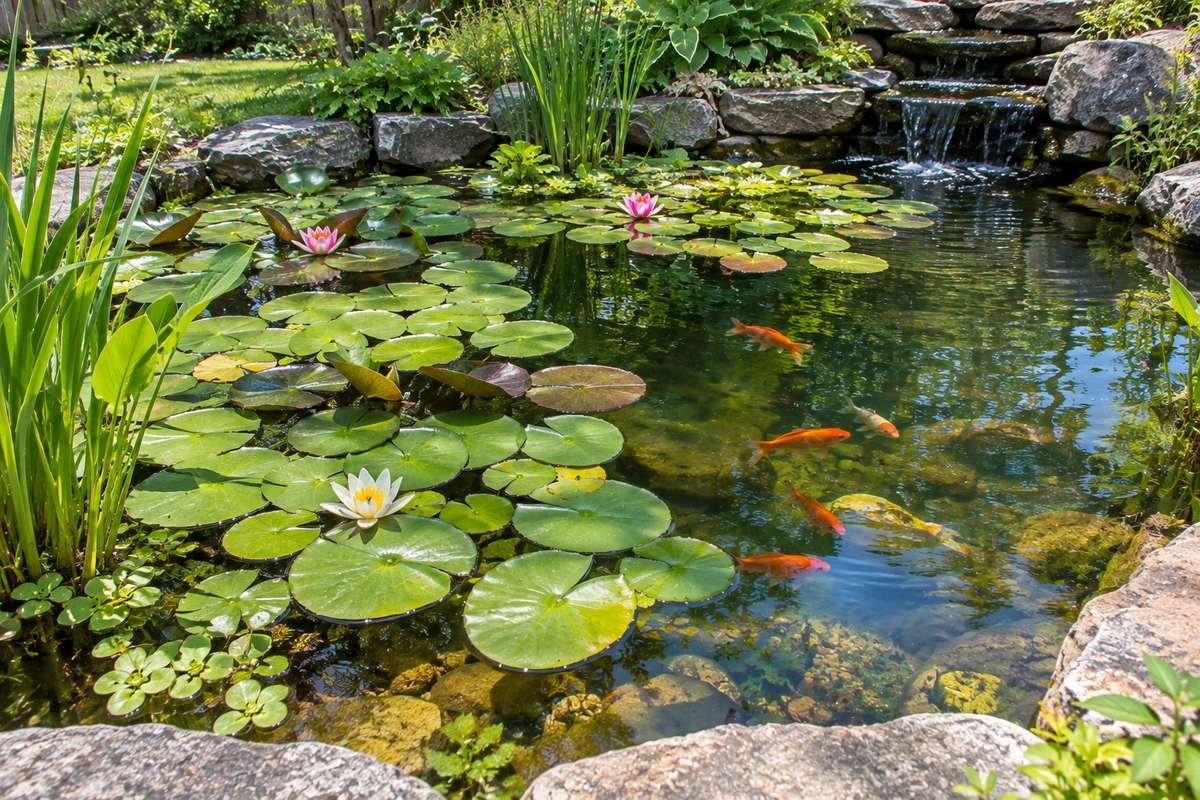
Plants are one of the best long-term fixes. They use nutrients algae would otherwise eat, and surface leaves block sunlight. Let plants cover up to 50 percent of the water surface. Water lilies are a common choice.
5. Remove leaves and stop runoff
Net out fallen leaves and dead plant parts before they rot. If muck has already built up on the bottom, our pond vacuum guide explains how to remove it. Keep lawn fertilizer and grass clippings away from the pond, and don’t let rain wash soil or fertilizer into it. Keeping fertilizer, leaves, and grass clippings out of the pond cuts extra nutrients.
6. Make partial water changes
Swapping out some water dilutes nutrients. The Tetra GreenFree UV clarifier guide suggests regular partial water changes of up to 25 percent of the pond volume. Always add a water conditioner when you add tap water. Chlorine harms fish, and the U.S. Environmental Protection Agency (EPA) says more than one in five Americans gets drinking water treated with chloramine (a longer-lasting form of chlorine some water systems use). If your water has chloramine, choose a conditioner labeled to treat chloramine as well as chlorine.
7. Add a UV clarifier for faster results
A UV clarifier is a sealed tube with an ultraviolet bulb inside. Your pump pushes water through it, and the UV light damages the floating algae. The dead algae clump together so your filter can catch them. It is one of the quickest ways to clear green water that won’t go away. It works best when steps 1 through 6 are already in place, because it treats the algae, not the nutrients behind them. The next section covers how to choose one.
How to choose and use a UV clarifier
A UV clarifier has to match two numbers: your pond’s volume and your pump’s flow. If you don’t know your pond’s gallons, use our pond calculator.

Match the bulb to the pond
Makers rate each clarifier for a maximum pond size. Tetra’s guide, for example, gives these sizes for its GreenFree line:
| Bulb | Pond size, up to | Best pump flow through the unit |
|---|---|---|
| 5 watts | 660 gallons | 330 gallons per hour |
| 9 watts | 1,800 gallons | 900 gallons per hour |
| 18 watts | 4,400 gallons | 2,200 gallons per hour |
| 36 watts | 8,800 gallons | 4,400 gallons per hour |
These numbers apply only to Tetra units. Other brands rate their clarifiers differently, so always check the maker’s chart. Look for a rating for ponds with fish. OASE, for example, rates its Vitronic 18 for a pond with fish at half the size of a pond with no fish, and for a koi pond at one quarter. Fish ponds need a larger unit. Tetra’s guide also says it’s still safe to use a larger unit than the chart calls for.
Get the flow right
If water moves too fast through the clarifier, it doesn’t spend enough time under the light. Tetra recommends keeping flow within about 10 percent of the rated flow for each model. To check your flow, time how long it takes to fill a 5-gallon bucket from the clarifier’s discharge hose. Divide 3,600 by the seconds, then multiply by 5. For example, a 20-second fill works out to 900 gallons per hour. If the flow is too high, a valve between the pump and the clarifier can slow it down. For more on choosing a pump, see step 5 of our pond building guide.
How long it takes and how to keep it working
- Time to clear: Tetra says normal green water clears in about one week. Thick blooms can take two to three weeks.
- Bulb life: UV bulbs get weaker even when they still glow. Tetra says to replace its bulbs after about 11 months of use.
- Filter: A clarifier does not replace a filter. Water clarity still depends on good filtration.
- Medicine: Turn the clarifier off while you treat the pond with fish medicine.
- Safety: Plug it into an outlet with GFCI protection, a safety device that shuts off power if it senses electricity leaking, such as into water. Never look straight at a bare UV bulb, because it can damage your eyes.
Barley straw, dyes and algaecides
You will see these suggested often. They can help in some ponds, but each one has limits.
Barley straw
Penn State Extension says barley straw does not kill existing algae. As the straw slowly breaks down, it slows the growth of new algae. It works best when added before algae appear, from fall through early spring. It can take 1 to 2 weeks to start working in water above 70°F and 6 to 8 weeks in water below 50°F. Once working, it lasts about six months.
For a small garden pond, hold the straw in a small net or nylon stocking. Its general rate is about 10 to 25 grams of straw per square meter of pond surface. A square meter is a little under 11 square feet. Don’t add more than you need. Too much straw can use up oxygen as it rots and kill fish, especially in hot weather. Scientists still don’t fully understand how barley straw works, so treat it as a helper, not a cure. Our full guide to barley straw for ponds covers dose by pond size, timing, placement and what the research shows.
Pond dye
Dye tints the water so less sunlight reaches the algae. Dye does not remove nutrients. It also shades the plants that compete with algae, and it does little about algae that float right at the surface. Our guide to pond dye covers how much to use, safety, and why it should not go into a pond that is already green.
Algaecides
Chemical algae killers are a last resort. Copper products can harm fish and plants, and they are especially risky in water with low alkalinity, a measure of how well water resists pH (how acidic or alkaline the water is) changes. At alkalinity below 50 parts per million, Clemson calls copper extremely risky. Killing a large bloom all at once can also cause the oxygen crash described above. Kansas State advises treating no more than one quarter of a pond at a time. If you use any algaecide, follow the label exactly and keep aeration running.
How long it takes to clear green water
| Method | Typical time | Source |
|---|---|---|
| New pond settling in | About 3 weeks | Clemson Extension |
| UV clarifier, normal green water | About 1 week | Tetra clarifier guide |
| UV clarifier, thick bloom | 2 to 3 weeks | Tetra clarifier guide |
| Barley straw, water above 70°F | 1 to 2 weeks to start working | Penn State Extension |
| Barley straw, water below 50°F | 6 to 8 weeks to start working | Penn State Extension |
Plants, less feeding and fewer fish work more slowly, but they are the changes that keep the water clear once it clears.
5 products that help clear green water
These products are sold on Amazon and match the steps above. We selected them based on manufacturer specifications, checked on October 12, 2026. Prices change, so check the current listing before you buy. We have not used these products ourselves.
| Product | What it does | Rated for |
|---|---|---|
| Tetra GreenFree UV Clarifier UVC-5 | UV clarifier, 5 watts | Ponds up to 660 gallons |
| OASE Vitronic 18 | UV clarifier, 18 watts | About 2,640 gallons with fish, per OASE |
| Aquascape UltraKlean 3500 | Pressure filter with a 28-watt UV clarifier | Ponds up to 3,500 gallons |
| API Pond Master Test Kit | Tests pH, ammonia, nitrite, and phosphate | 500+ tests |
| API Pond Chlorine and Heavy Metal Neutralizer, 32 oz. | Makes tap water safe for fish | Use when adding tap water |
Best for small ponds
Tetra GreenFree UV Clarifier UVC-5

This simple, low-cost clarifier works for small ponds and water gardens up to 660 gallons. Tetra provides a clear sizing chart and flow guide, making it easy to set up correctly. The best flow rate for this model is about 330 gallons per hour, so a larger pump will push water through too fast.
- Bulb: 5 watts, rated for up to 11 months of use
- Pond size: up to 660 gallons
- Warranty: 3-year limited
- Good: Low price
- Good: Clear sizing and flow instructions from the maker
- Watch out: Only the 5-watt unit showed up on Amazon when we checked
- Watch out: Needs a small pump or a valve to keep flow low
Best for medium fish ponds
OASE Vitronic 18 UV Clarifier

This 18-watt clarifier covers a much bigger pond than the Tetra. The Amazon listing says it suits ponds up to 5,280 gallons, but OASE’s own specifications show that figure is for a pond with no fish. OASE rates it for about 2,640 gallons with fish and about 1,320 gallons with koi. Clear tubing adapters let you see that the bulb is on. A 36-watt version is listed too. OASE says it works best with one of its own biological filters, so plan on a filter if you don’t already have one.
- Bulb: 18 watts
- Pond size (OASE specs): about 2,640 gallons with fish, 1,320 with koi, or 5,280 with no fish
- Maximum flow: about 925 gallons per hour (3,500 liters per hour)
- Fits: new or existing pond systems
- Good: Covers a medium pond with fish at a mid-range price
- Good: Clear adapters show it is working
- Watch out: No filter included
Best filter and UV in one
Aquascape UltraKlean 3500 Filter with UV Clarifier

If your pond has no real filter, this unit adds both at once. It is a pressure filter with biological media and a built-in 28-watt UV clarifier, rated for ponds up to 3,500 gallons. Aquascape says the design uses no sponges, which reduces cleaning.
- UV bulb: 28 watts
- Pond size: up to 3,500 gallons
- Warranty: 3-year limited
- Good: Filter and clarifier in one unit
- Good: Room to grow for a medium pond
- Watch out: Costs much more than a clarifier alone
- Watch out: You still need a pump sized for your pond
Best for finding the cause
API Pond Master Test Kit

A test kit tells you whether fish waste and nutrients are building up, which is the root cause of most green water. This kit uses liquid tests and color cards and covers more than 500 tests.
- Tests: pH, ammonia, nitrite, and phosphate
- Includes: 6 test bottles, 4 test tubes, and 3 color cards
- Good: Covers the main readings tied to algae
- Good: Enough tests for a long time
- Watch out: Does not test nitrate
- Watch out: Liquid tests take a few minutes each
Best for water changes
API Pond Chlorine and Heavy Metal Neutralizer

Partial water changes help clear green water, but you have to make tap water safe for fish first. This conditioner removes chlorine and heavy metals and is made for use when filling, adding, or changing pond water.
- Size: 32 fluid ounces
- Use: each time you add tap water
- Good: Works right away, according to the listing
- Watch out: The listing does not mention chloramine. If your city uses chloramine, choose a conditioner that says it treats it
Green pond water FAQ
Is green pond water bad for fish?
Ordinary green water from floating algae is mostly a clarity problem. The risk comes when a large bloom dies off and uses up oxygen. A blue-green algae bloom, which can look like spilled paint on the surface, can also produce toxins. Keep pets and people out of that kind of water.
Should I drain my pond to get rid of green water?
Usually not. A full drain doesn’t remove the causes, such as too many fish, too much feeding, and too few plants, and the pond has to settle in again like a new one. Clemson Extension lists flushing the pond and adding new water as ways to reduce algae. Tetra suggests partial water changes of up to 25 percent at a time, which dilutes nutrients without starting over.
How long does a UV clarifier take to clear green water?
Tetra says normal green water clears in about one week with a correctly sized clarifier. Thick blooms can take two to three weeks. If nothing changes after that, check the pump flow and whether the bulb is more than about 11 months old.
Does barley straw clear green pond water?
Barley straw does not kill algae that are already there. Penn State Extension says it slows new growth and works best when you add it before algae appear. It can take 1 to 8 weeks to start working, depending on water temperature.
Why does my pond turn green every summer?
Algae grow faster in warm water and strong sun. If your pond has extra nutrients from fish waste, food, leaves or fertilizer, summer is when a bloom shows up. More plant cover and less feeding help prevent it.
Is green water the same as string algae?
No. Green water is made of single-celled algae floating in the water. String algae grows in long strands on rocks, liners, and waterfalls. UV clarifiers target the single-celled algae in green water, so they won’t remove string algae. You have to pull string algae out by hand or control it in other ways.
Where to start
Start with the free fixes. Feed fish less, net out leaves, and add plants until about half the surface is covered. If the pond is new, give it about three weeks. If the water is still green after that, add a UV clarifier sized for your pond and your pump. Use a test kit to see whether nutrients are dropping, and keep a water conditioner on hand for partial water changes. Save algaecides for last, and treat only part of the pond at a time.