

Most ponds need a pump that turns over the entire pond volume at least once an hour. A 1,000-gallon pond with fish needs about 1,000 gallons per hour (GPH). Add a waterfall, and you may need more. But here’s the part most guides skip: the GPH printed on the box is what the pump moves with no lift at all. Once the water has to climb to a waterfall, real flow drops, sometimes to half the box number or less.
So the right question isn’t just how many GPH you need. It’s which pump still delivers that flow at your height. The finder below checks 26 popular pond pumps against their makers’ flow charts and shows you which ones really deliver.
Pond pump flow finder
Enter the flow you need and how high the water has to climb. The finder checks each pump’s own flow chart and shows which ones really deliver it at your height.
Not sure of your numbers? Work them out here
Flow: at least the pond volume each hour (half that is fine for plants only), or the waterfall flow if that is higher. Head: 1 foot per foot of lift, 1 foot per 10 feet of tubing, 1 foot per elbow. These are the same rules as our pond calculator.
| Pump | Box rating | Flow at your height | Watts | Cost to run a year |
|---|
Flow at your height comes from each maker’s published flow chart. Between the listed heights, the finder draws a straight line, so treat those numbers as close estimates. Running cost assumes the pump runs all day, every day, at full power.
Pond pump flow finder by PondBrief · pondbrief.com
Step 1: Work Out How Much Flow You Need
Start with turnover, how often the pump moves the pond’s entire volume. For a pond with fish, a filter or a waterfall, aim for at least once an hour. A plants-only pond can use once every two hours. Pump makers give the same range. Aquascape, for example, says a pump should turn the pond over at least once every one to two hours.
Then check the waterfall. Size a waterfall by the width of its spillway, the lip the water pours over. Plan on about 50 GPH per inch of width for a thin film, 100 GPH per inch for a medium sheet about 1/2 inch deep, and 200 GPH per inch for a heavy flow about 1 inch deep. A 12-inch spillway with a medium sheet needs about 1,200 GPH. Pump makers aim a little higher. Aquascape suggests at least 1,500 GPH per foot of width for a home waterfall, about 125 GPH per inch, so plan toward that if you want a full, even sheet.
Use whichever number is higher. If the pond needs 1,000 GPH for turnover and the waterfall needs 1,200, size the pump for 1,200.
Step 2: Work Out Your Head Height
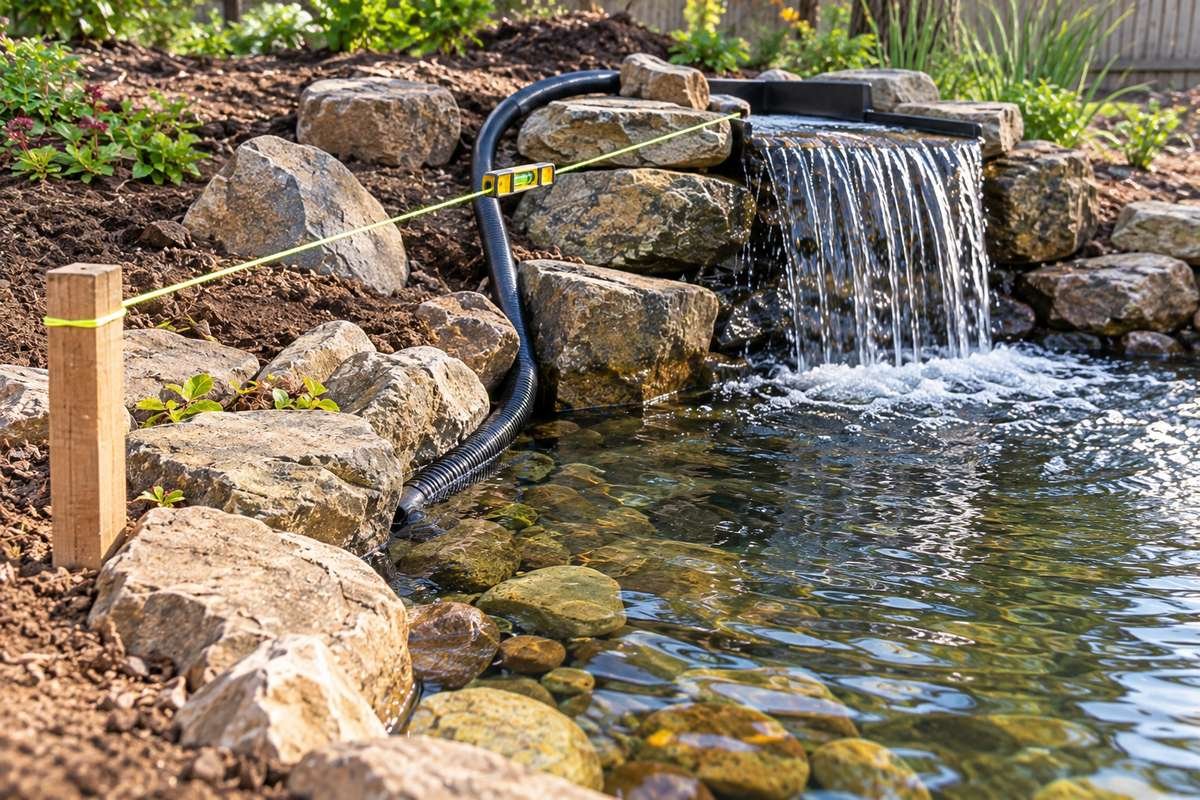
Head height is how hard the pump has to work to push water where you want it. It starts with lift, the height from the pond surface to the top of the waterfall. Tubing and fittings add to it, because water loses speed as it rubs along the pipe and turns corners.
A simple rule many pond builders use:
- 1 foot of head for every foot of lift
- 1 foot of head for every 10 feet of tubing
- 1 foot of head for every 90-degree elbow
A pressurized filter or UV clarifier in the line adds a few feet more. So a waterfall 3 feet above the pond, fed by 20 feet of tubing with one elbow, works out to about 6 feet of head. The “work them out here” section of the finder does this math for you, and so does our pond calculator.
Why the Number on the Box Misleads
Pump boxes lead with the highest number the pump can reach: its flow at 0 feet of head. That is the water it moves when it doesn’t have to lift anything. The flow chart, usually on the back of the box or in the manual, lists the flow at each height. That chart is the number that matters.
Here is what that looks like for the 1,000-gallon pond above, which needs 1,200 GPH at 6 feet of head:
| Pump | Box rating | Flow at 6 feet | Enough? |
|---|---|---|---|
| Aquascape Ultra 1500 | 1,480 GPH | about 1,140 GPH | No |
| Atlantic TidalWave3 TT1500 | 1,640 GPH | about 918 GPH | No |
| Beckett FC2100 | 2,100 GPH | about 1,210 GPH | Barely |
| Aquascape AquaSurge 2000 | 2,193 GPH | about 1,773 GPH | Yes |
Both of the first two pumps look big enough on the box, and both fall short once the water climbs 6 feet. The TidalWave3 has the higher box rating but delivers less at that height. Pumps lose flow at different rates as head goes up, so two pumps with the same box rating can perform very differently on your waterfall.
The loss grows as the water climbs higher. The Atlantic TidalWave3 TT4000 is rated at 4,490 GPH. At 10 feet, its own chart shows 1,785 GPH, which is about 40 percent of the box number.
How to Pick From the Pumps That Fit
Match the pump type to the job. Solids-handling pumps like the Aquascape AquaForce can pass debris up to about 1/4 inch, so they handle a dirty pond well. Mag-drive pumps like the Aquascape Ultra are made for fountains, small ponds, and feeding external filters. If you are adding a fountain, our pond fountain guide shows how high it should spray. Waterfall pumps like the Beckett FC series and the larger Atlantic and AquaSurge models are built to push a lot of water uphill.
Look at running cost, not just price. A pond pump usually runs around the clock, so the electric bill adds up fast. At 18 cents per kilowatt-hour, close to the average US home rate in 2026, every 100 watts costs about $158 a year. That is why the finder lists the cheapest pumps to run first. A pump that costs $50 more but uses 80 fewer watts pays for itself in well under a year.
Leave a little extra. Pick a pump that beats your target with some flow to spare. Tubing gets slimy, intakes clog with leaves, and real installs rarely match the math exactly. An adjustable-flow pump gives you extra flow that you can turn down if the waterfall runs too strong.
Use wide enough tubing. Narrow tubing holds back a big pump. Aquascape lists the most flow its flexible pipe can carry as about 2,200 GPH for 1.5 inch, 4,800 GPH for 2 inch and 11,500 GPH for 3 inch. If your pump moves more than your pipe can carry, step up a size.
Where the Pump Data Comes From
Every flow number in the finder comes from the pump maker’s own published chart, from Aquascape, Atlantic, and Beckett. We left out pumps whose makers only show a curve or don’t publish one, because reading numbers off a picture would just be a guess. Between the heights a maker lists, the finder draws a straight line, so in-between values are close estimates. Watts are the maker’s listed figures, and for adjustable pumps they are the watts at full flow.
Models and charts change, so check the chart on the box or the maker’s page before you buy. If your pump isn’t listed, its chart works the same way: find your head height and read across to the flow.
Common Questions
Can a pond pump be too big?
Yes. Too much flow can splash water out past the edges of a small waterfall, and you pay to run power you don’t need. You can easily turn down a big pump with a valve or an adjustable model, but you can’t make a small pump push more. Size for your target with a little to spare, or choose an adjustable-flow pump.
What size pump do I need for a 500 gallon pond?
With fish or a filter, about 500 GPH at your head height. With plants only, about 250 GPH is enough. A waterfall may need more. Work out the waterfall flow too, then enter the higher number and your head height in the finder. To match the pump to your filter, see our pond filter guide.
How do I read a pump flow chart?
Find your head height on the chart, then read the flow listed for that height. If your height falls between two listed numbers, the flow will be somewhere between the two flows. The height where flow reaches zero is the pump’s maximum head, and you want to stay well below it.
Building from scratch? Our guide on how to build a pond shows where the pump, tubing, and waterfall go, step by step.