

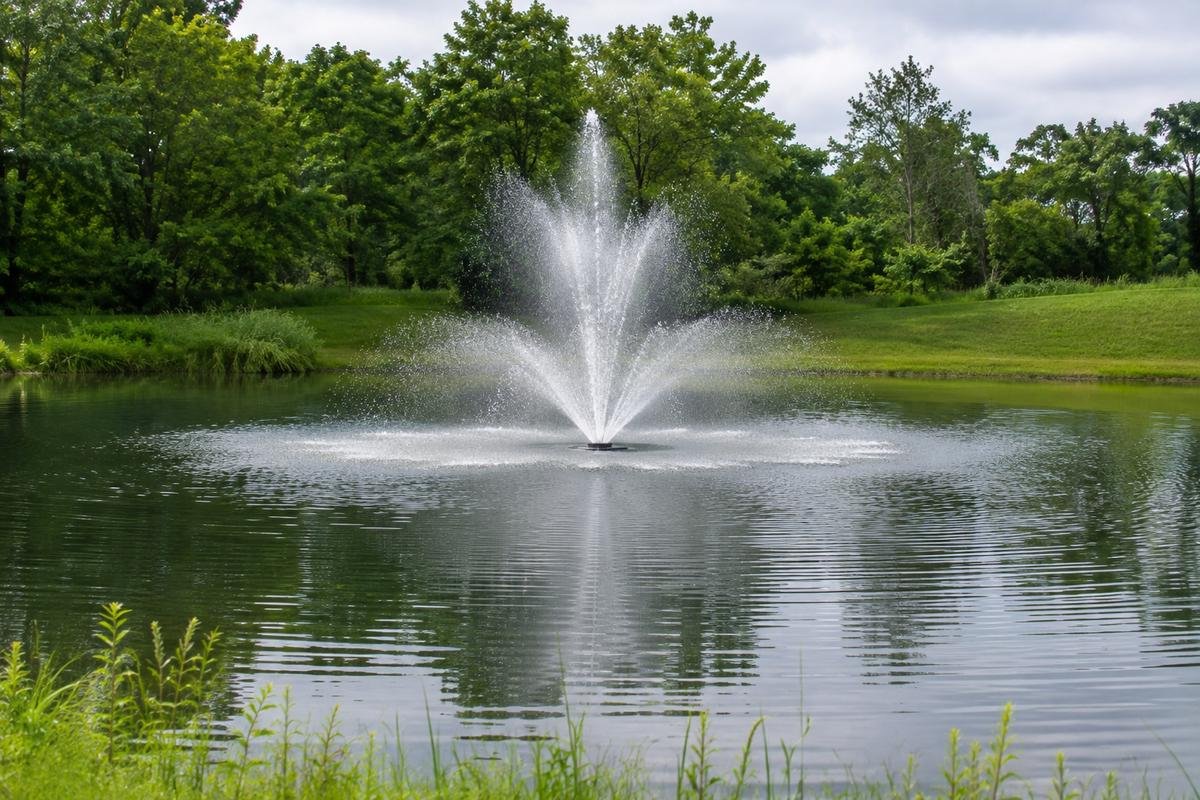
A pond fountain sprays water into the air for looks and sound, and it adds a little oxygen at the surface. The right pond fountain depends on your pond’s size, depth, and whether you have power nearby. For a backyard pond, keep the spray no taller than half the pond’s narrowest width so the water lands back in the pond.
PondBrief is a participant in the Amazon Services LLC Associates Program, an affiliate advertising program designed to provide a means for sites to earn advertising fees by advertising and linking to Amazon.com. As an Amazon Associate, we earn from qualifying purchases.
This guide covers the main types of pond fountains, how to size one, where to put it, what it does for fish, and four fountains worth a look. It also has a planner that does the sizing for you. We have not tested these fountains ourselves. Specs come from the makers and their product listings.
Table of Contents
Do You Need a Pond Fountain?
Many ponds do fine without a fountain. People add one because they like the look and the sound of moving water. A fountain also moves surface water and adds some oxygen as droplets fall back.
That oxygen boost is small. As our pond aeration guide explains, spraying water is a weak way to add oxygen and does little to mix the deeper water. The Pond Guy’s fountain buying guide says a fountain alone will not provide enough aeration in ponds deeper than 6 feet, and it suggests a bottom aeration system for those ponds. If you keep fish, think of a fountain as a bonus, not your only oxygen source.
Types of Pond Fountains
| Type | How it works | Best for |
|---|---|---|
| Submersible pump with a fountain nozzle | A pump sits on the pond floor and pushes water up a short pipe to a nozzle just above the surface. | Most backyard and garden ponds |
| Floating spray fountain | The pump hangs under a float, so you don’t have to plumb anything. You anchor it and run the cord to shore. | Garden ponds where you want a quick setup |
| Solar fountain | A small pump runs from a solar panel, with no outlet needed. | Tiny ponds, tubs and bird baths with full sun |
| Aerating floating fountain | A larger motor under a float throws a big spray, often 1/2 horsepower or more. | Large ponds, usually a fraction of an acre or more |
| Spitter or statue | A small pump sends a stream through a statue or ornament at the pond edge. | Small ponds where you want sound more than spray |
Solar fountains need direct sun to run. Models without a battery slow down or stop when a cloud or shade covers the panel. Some include a battery so they keep going for a while after dark, but even those are small pumps meant for small water features.
How to Size a Pond Fountain
- Measure the narrowest width of your pond. Water Garden, a UK pond supplier, says in its fountain guide that the display should be no more than half the width of the pond’s narrowest part. A pond 6 feet across at its narrowest suits a spray of about 3 feet or less. The goal is to keep the water in the pond, even on a windy day.
- Check the pump’s flow at your height, not its maximum. Pumps move less water the higher they push it. TotalPond’s 300 GPH fountain pump, for example, lists 102 gallons per hour at 5 feet of lift and nothing at its 6.2-foot maximum. Pick a pump rated for more flow than you need at your fountain height.
- Check the depth. Floating fountains need enough water under them. Airmax lists a minimum depth of 24 inches for its EcoSeries 1/2 HP fountain, for example.
- Measure the cord run. Measure from where the fountain will sit to your outdoor outlet. The Pond Guy notes that cords come in several lengths, so measure before you buy.
For large ponds, the motor size sets the spray. The Pond Guy says horsepower largely decides how tall and wide a fountain sprays, and that a spray too big for the pond will dominate it in both look and sound. Our pond calculator works out your pond’s gallons if you also need to size a filter or pump.
Pond Fountain Planner
Enter your pond’s narrowest width and depth, and tell the planner about power and fish. It suggests a fountain type, the tallest spray that fits, and anything else to plan for.
Pond Fountain Planner
Fill in your pond and press Plan my fountain.
Fountain planner by PondBrief. Spray limit uses the half the narrowest width rule. Always follow the maker’s manual.
4 Pond Fountains Worth a Look
These cover the main types, from a tiny solar fountain to a fountain for a quarter-acre pond. The order follows pond size, not a ranking. We checked each listing on Amazon on 3 Nov 2026, and each was sold by Amazon, the maker or the maker’s authorized seller.
Best for tiny ponds and tubs
AISITIN 3.5W Solar Fountain Pump

This is a small solar pump with a separate panel on a 9.8 foot cord, so the pump can sit in the water while the panel sits in the sun. AISITIN says it needs no batteries or outlet. It comes with several nozzles, including rotating, double and straight spray styles.
It has no battery, so it only runs while sun reaches the panel. It suits a patio tub, a bird bath or a very small pond where you want gentle movement, not oxygen for fish.
- Type: solar, no battery
- Power: 3.5 watt panel
- Cord: 9.8 feet, pump to panel
- Nozzles: rotating, double and straight styles
Best for small garden ponds
Tetra Water Garden Pump 325 GPH plus TetraPond Fountain Set

Tetra’s 325 GPH Water Garden Pump is made for small outdoor ponds and powers fountain heads, filters and waterfalls. It comes with adapters for 1/2 inch and 3/4 inch tubing and a 3 year limited warranty.
The pump has no fountain head of its own, so pair it with the TetraPond Fountain Set. The set includes spray, bell and frothy patterns, adjusts in height for different pond depths, and has adapters for all Tetra Water Garden Pumps. Tetra suggests choosing a pump a little more powerful than you need, since tubing and filters cost some flow.
- Pump flow: 325 GPH (gallons per hour)
- Patterns: spray, bell, frothy
- Tubing: 1/2 and 3/4 inch adapters on the pump
- Warranty: 3 years on the pump, 1 year on the fountain set
Best plug and play floating fountain
Alpine Corporation FTC102 Floating Spray Fountain

The FTC102 is a floating fountain with the pump built in, so there is no pipe or nozzle to set up. Alpine lists a 398 GPH pump that sprays up to 3 feet high and 2.5 feet wide, which suits a pond about 6 feet or more across at its narrowest.
It has a ring of 48 LED lights that cycle through red, white and blue on their own. The pump and lights have separate plugs, so you can run the spray without the lights. It comes with a 33 foot cord.
- Type: floating, pump built in
- Pump flow: 398 GPH
- Spray: up to 3 feet high, 2.5 feet wide
- Cord: 33 feet
- Lights: 48 color-changing LEDs
Best for large ponds
Airmax EcoSeries 1/2 HP Floating Fountain

The EcoSeries is a floating fountain for bigger ponds. Airmax says it aerates ponds up to 1/4 acre and 6 feet deep, and that it runs in as little as 24 inches of water. It pulls water from below the float, which helps move more of the pond.
It comes with three nozzles, Classic, Trumpet and Crown and Trumpet, plus a plug-in control panel with timers and a 100 foot cord. The motor is a 1/2 HP, 115 volt unit. For ponds deeper than 6 feet, The Pond Guy suggests adding bottom aeration as well.
- Type: floating aerating fountain
- Motor: 1/2 HP, 115 volts
- Pond size: up to 1/4 acre, 6 feet deep
- Minimum depth: 24 inches
- Cord: 100 feet
Where to Put a Pond Fountain
- Near the middle. For a small pond, Water Garden’s guide suggests placing the pump in the center, so the spray lands well inside the edges.
- Away from water lilies. Waterside Nursery’s water lily advice says not to place lilies near splashing water such as a fountain, because constant splashing rots the leaves. Our pond plants guide covers where lilies grow best.
- Raised off the bottom, if the pond has sludge. Pondkeeper suggests setting the pump on a stone block so it does not clog with dirt and debris.
- Within reach of a safe outlet. Aquascape’s pump manual says to plug pond pumps only into a grounded GFCI outlet, have a qualified electrician install an outdoor outlet if you need one, and not use extension cords. It also says to unplug the pump before you take it out of the pond.

Pond Fountains, Fish, and Oxygen
Oxygen in a pond runs lowest at night, and it can drop further in hot weather or after several cloudy days. A fountain helps a little at the surface, and it helps more in a shallow pond than a deep one. The University of Maryland Extension’s pond aeration basics says surface aerators mix water best down to about 5 feet, and that deeper ponds typically need compressed air pumped to diffusers. It also notes that aerators are often run overnight, when oxygen is lowest.
If you keep fish, run the fountain overnight in summer rather than switching it off at bedtime. If your pond is deep or crowded, add an air pump with a diffuser. The pond aeration guide shows how to size one.
Pond Fountains in Winter
Cold weather is hard on fountains. Kasco, which makes floating fountains, says in its winter maintenance guide that in places where more than about an inch of ice forms, it is best to take a floating fountain out of the water for the winter. Spray can freeze on the unit and build up ice that can damage the motor, and ice that keeps freezing and thawing around a unit left in the water can crack the float. Kasco suggests storing it somewhere above freezing.
Small submersible fountains can usually be removed from the pond, too. Clean the pump and store it as the maker’s manual says. Our seasonal pond care guide covers the rest of the fall and winter checklist.
Common Pond Fountain Mistakes
- A spray that is too tall. Wind blows the water out of the pond and the level drops. Keep the spray under half the narrowest width.
- Counting on a fountain for all the oxygen. In a deep or crowded fish pond, add an air pump and diffuser.
- Buying by maximum flow. Check the pump’s flow at the height you need.
- Using an extension cord. Plug into a grounded GFCI outlet rated for outdoor use, as the pump maker advises.
- Solar in the shade. A solar fountain needs direct sun on the panel to run.
- Splashing the lilies. Keep fountains away from water lilies and other plants that dislike wet leaves.
- Leaving a floating fountain in the ice. Where more than about an inch of ice forms, take it out before winter.
Quick Answers
Does a pond fountain add oxygen?
Yes, a little. Falling droplets pick up some oxygen at the surface. It is a weak way to add oxygen, though, and does little for deeper water. In ponds deeper than 6 feet, The Pond Guy says a fountain alone is not enough and suggests adding a bottom aeration system with a diffuser.
How high should a pond fountain spray?
Keep the spray no taller than half the pond’s narrowest width. A pond 8 feet across at its narrowest suits a spray of about 4 feet or less. That keeps the water in the pond when the wind blows.
Can I leave a pond fountain on all the time?
Many pond pumps are made to run all the time. Aquascape, for example, says its small fountain kit pumps are designed for continuous operation. If you keep fish, leave the fountain running overnight in summer, since oxygen is lowest at night. Check your model’s manual.
Do solar pond fountains work in the shade?
Not well. A solar fountain needs direct sun on the panel. Without a battery, it slows down or stops in shade or clouds. Models with a separate panel on a cord let you put the panel in the sun while the fountain sits in a shady spot.
Should I take my pond fountain out in winter?
For floating fountains, Kasco says to take them out of the water where more than about an inch of ice forms, and to store them above freezing. Spray can freeze on the unit, and ice can crack the float.
Is a fountain bad for water lilies?
It can be. Water lilies do not like splashing water. Waterside Nursery says constant splashing from a fountain or waterfall rots the leaves, so keep lilies out of the spray.
Where to Go Next
Need a pump to run your fountain? Our guide to what size pond pump you need covers flow and head height. If you keep fish, read the pond aeration guide next, then the pond filter guide for clear water.