

A pond vacuum pulls the muck off the bottom of your pond without draining it. Leaves, fish waste, and dead algae settle there over time. As leaves, fish waste, and algae break down, they add organic matter and nutrients that can worsen water quality.
PondBrief is a participant in the Amazon Services LLC Associates Program, an affiliate advertising program designed to provide a means for sites to earn advertising fees by advertising and linking to Amazon.com. As an Amazon Associate, we earn from qualifying purchases.
This guide explains the two kinds of pond vacuums, which one fits your pond, four models worth a look, and how to vacuum without stressing your fish. It also includes a quick picker to help you narrow it down.
Table of Contents
What a Pond Vacuum Does
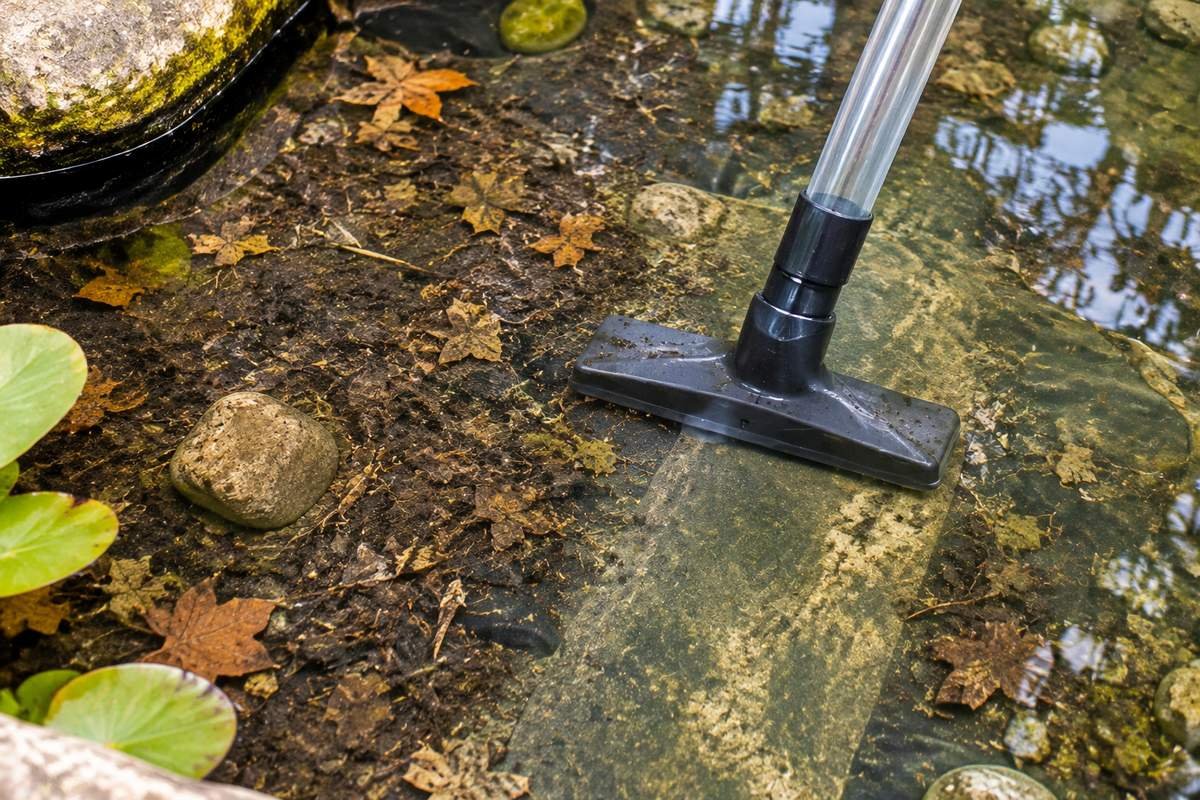
A pond vacuum works like a wet vacuum with a long hose. You move a nozzle along the bottom, and the motor pulls water and muck into a tank. When the tank fills, the dirty water drains out through a second hose, usually onto a garden bed.
It is best at loose muck, fallen leaves, and string algae. It will not fix the cause of the muck, such as too many fish, overfeeding, or leaves from nearby trees. And it does not replace your filter. Texas A&M AgriLife notes that fallen leaves can foul pond water and clog filters, so keeping leaves out matters as much as removing muck.
Single-Tank or Two-Chamber: The Two Kinds
This is the biggest difference between pond vacuums, and it decides how long the job takes.
Single-tank vacuums
These have one tank that fills, then empties through the discharge hose. They are often called stop-and-drain vacuums. The CleanSweep 1400 shuts off its motor while the tank drains, then restarts. The OASE PondoVac Classic also uses one tank that empties automatically, though OASE does not say whether suction pauses while it drains. They cost less and work well for small ponds that you clean once or twice a year.
Two-chamber (nonstop) vacuums
These have two chambers. One fills while the other drains, so the vacuum keeps pulling the whole time. The OASE PondoVac 4 and The Pond Guy ClearVac work this way. They cost more, but they are much faster on a large pond or a thick layer of muck.
Pond Vacuum Picker
Pond Vacuum Picker
Answer four questions to see which type of pond vacuum fits your pond and which models to look at first.
The picker matches your answers to each maker’s published specs. It is a starting point, not a guarantee.
4 Pond Vacuums Worth a Look
These picks are based on each maker’s published specs. Check the depth rating and hose length against your own pond before you order.
Best for small ponds and light cleaning
OASE PondoVac Classic

The PondoVac Classic is a single-tank vacuum. It fills a 27 liter (about 7 gallon) tank, and the tank empties automatically through the discharge hose when it is full. OASE does not say whether suction pauses while it drains. It works well for a small pond that you clean once or twice a year.
OASE’s depth figures differ. Its US spec table lists a maximum suction depth of 1.8 meters (about 6 feet), while its UK and Australian pages, and a feature list on the US page, say 2 meters (about 6.5 feet). The US description also mentions powerful suction up to 1.5 meters (about 5 feet), which reads as a working depth rather than a maximum. Confirm the rated depth for the exact model you buy.
Every OASE page we checked lists a 4 meter (13 foot) suction hose and a 2 meter (7 foot) discharge hose. OASE lists a maximum flow of 800 gallons per hour. It comes with four nozzles: a variable universal nozzle, a string algae nozzle, a flat nozzle with a rubber lip, and a crevice nozzle.
- Motor: 1,400 watts
- Type: Single tank, empties automatically
- Maximum suction depth: 1.8 or 2 meters, depending on the OASE page (see the notes below the table)
- Flow: Up to 800 gallons per hour
- Hoses: 13 foot suction, 7 foot discharge
- Cord: 13 feet
- Weight: 19.5 pounds (OASE US page)
- Warranty: 2 years, limited
Best for bigger, deeper ponds
OASE PondoVac 4

The PondoVac 4 has two chambers that fill and empty in turn, so it keeps vacuuming while it drains. That makes it the better choice for a large pond or a thick layer of muck. OASE lists a maximum flow of 1,300 gallons per hour.
OASE lists a maximum suction depth of 2.4 meters (about 7.9 feet), the deepest of the four here. Its manual says suction drops past 2 meters (about 6.5 feet). The suction hose is 5 meters (16 feet). OASE lists the discharge hose as 2.4 meters in one place and 2.5 meters in another, about 8 feet either way.
It is also the heaviest. OASE’s US page lists 14 kilograms (about 31 pounds). It comes with five nozzles, four aluminum tubes, one clear tube and a dirt collection bag. OASE adds a third warranty year if you register it.
- Motor: 1,700 watts
- Type: Nonstop, two chambers
- Maximum suction depth: 2.4 meters (about 7.9 feet), suction weakens past 2 meters
- Flow: Up to 1,300 gallons per hour
- Hoses: 16 foot suction, about 8 foot discharge (2.4 or 2.5 meters, see notes)
- Cord: 13 feet
- Weight: 14 kilograms, about 31 pounds (OASE US page)
- Warranty: 2 years, plus 1 year when registered
Best nonstop vacuum for most backyard ponds
The Pond Guy ClearVac

The ClearVac also uses two chambers, so it vacuums without stopping to drain. The ClearVac manual lists a 16 foot suction hose that is 1 1/2 inches wide and an 8 foot discharge hose. It comes with four nozzles: wide, gravel, narrow and string algae. The Pond Guy says its pump handles debris up to 3/8 inch.
The Pond Guy’s product page lists a 7 foot maximum depth, but the ClearVac manual (version 3.3) lists a 6 foot maximum operating depth. Confirm the limit in the manual that comes with your unit. The Pond Guy does not publish a flow rate or a weight. The manual lists a 3 year warranty, which does not cover the filter foam or o-rings.
- Motor: 1,600 watts
- Type: Nonstop, two chambers
- Maximum depth: 6 or 7 feet, depending on the source (see notes)
- Flow: Not published
- Hoses: 16 foot suction, 8 foot discharge
- Cord: 13 feet
- Weight: Not published
- Warranty: 3 years, filter foam and o-rings excluded
Best for shallow ponds on a budget
CleanSweep 1400
The CleanSweep 1400 is sold by Half Off Ponds, which does not name a separate maker, so all of its specs come from the seller. It is a single-tank vacuum. The motor shuts off when the chamber is full, then starts again after it drains.
Half Off Ponds lists a 6 foot maximum depth but recommends 3 feet or less. Follow the 3 foot recommendation unless the seller tells you otherwise. That makes it best for shallow water gardens. No flow rate is published. It comes with three nozzles, four extension tubes, and a debris bag that fits on the discharge hose and catches muck while the water drains.
- Motor: 1,400 watts
- Type: Single tank, motor pauses to drain
- Depth: 6 feet maximum listed, 3 feet or less recommended (seller)
- Flow: Not published
- Hoses: 13 foot suction, 6.5 foot discharge (seller)
- Cord: 12 feet, grounded
- Weight: 26 pounds (seller)
- Warranty: 2 years (seller)
Pond vacuums compared
On a phone, swipe the table sideways to see every column.
| Vacuum | Type | Maximum suction depth | Recommended working depth | Suction hose | Discharge hose | Flow rate | Weight | Warranty |
|---|---|---|---|---|---|---|---|---|
| OASE PondoVac Classic | Single tank | 1.8 or 2 m (note 1) | Not published | 13 ft | 7 ft | Up to 800 gal/h | 19.5 lb (OASE US) | 2 years |
| OASE PondoVac 4 | Two chambers, nonstop | 2.4 m (about 7.9 ft) | Suction weakens past 2 m (manual) | 16 ft | 2.4 or 2.5 m (note 2) | Up to 1,300 gal/h | About 31 lb (OASE US) | Up to 3 years |
| The Pond Guy ClearVac | Two chambers, nonstop | 6 or 7 ft (note 3) | Not published | 16 ft | 8 ft | Not published | Not published | 3 years |
| CleanSweep 1400 | Single tank | 6 ft listed (seller) | 3 ft or less (note 4) | 13 ft | 6.5 ft | Not published | 26 lb (seller) | 2 years (seller) |
Notes on the table
- PondoVac Classic depth: OASE’s US spec table lists 1.8 meters (about 6 feet). Its UK and Australian pages, and a feature list on the US page, list 2 meters (about 6.5 feet). Confirm the rated depth for the exact model you buy.
- PondoVac 4 discharge hose: OASE’s US spec table lists 2.4 meters. Its included parts list and the manual list 2.5 meters. Both are about 8 feet.
- ClearVac depth: The Pond Guy’s product page lists a 7-foot maximum depth, and the ClearVac manual lists 6 feet. Confirm the limit in the manual for your exact model.
- CleanSweep 1400 depth: Half Off Ponds lists a 6-foot maximum but recommends 3 feet or less. Follow the 3-foot recommendation.
How to Vacuum a Pond Without Stressing Your Fish
Fish handle a slow, careful cleaning far better than a sudden one. A water garden fact sheet from Oklahoma State University Extension notes that fish diseases almost always follow stress. These steps keep the job gentle.
- Pick a mild day. Spring and early fall work well. The Royal Horticultural Society says early autumn is the best time for a full clean-out, when many pond creatures are less active.
- Check the power. Plug the vacuum into a GFCI-protected outlet. Follow your vacuum’s manual for outdoor use and extension cords.
- Lay out the discharge hose. Point it at a garden bed or lawn where the water can soak in and will not run back into the pond or into a storm drain. The Pond Guy says returning the water to the pond can make it cloudy.
- Move small fish first. Before a bigger cleaning, move small or weak fish to a holding tub filled with pond water. The RHS suggests moving fish to a holding tank before a pond clean-out.
- Start in the shallow end. Keep the nozzle away from fish and move it slowly along the bottom. A slow pass lifts muck without stirring up a cloud. Larger fish can still be hurt if they swim into the nozzle, so watch where they are as you work.
- Clean part of the pond, not all of it. The RHS suggests cleaning only half the pond at a time so the creatures living in it can recover. It also suggests keeping a little silt, because it holds tiny organisms that help the pond.
- Leave the sides alone. Kansas State University warns against power washing the liner because helpful microorganisms live in the film on the sides. We suggest vacuuming the bottom and leaving the walls alone.
- Top up the pond. Add water slowly. Treat tap water with a dechlorinator first. The RHS also suggests adding tap water in small amounts, warmed in the sun first, so the pond temperature does not drop suddenly.
After a big cleaning, test the water for a few days. Our pond water test kit guide explains what each reading means.
Where the Muck Goes
Pond muck is mostly broken-down leaves, fish waste, and algae, and it can add organic matter to garden soil. OASE suggests using it in a flower bed. Direct the discharge water and solids to a garden area where the water can soak in and will not run back into the pond, into a storm drain, or onto a neighbor’s yard. Not all pond muck suits every planting, so start small. The CleanSweep 1400 comes with a bag that fits on the discharge hose, catching solids while the water drains away.
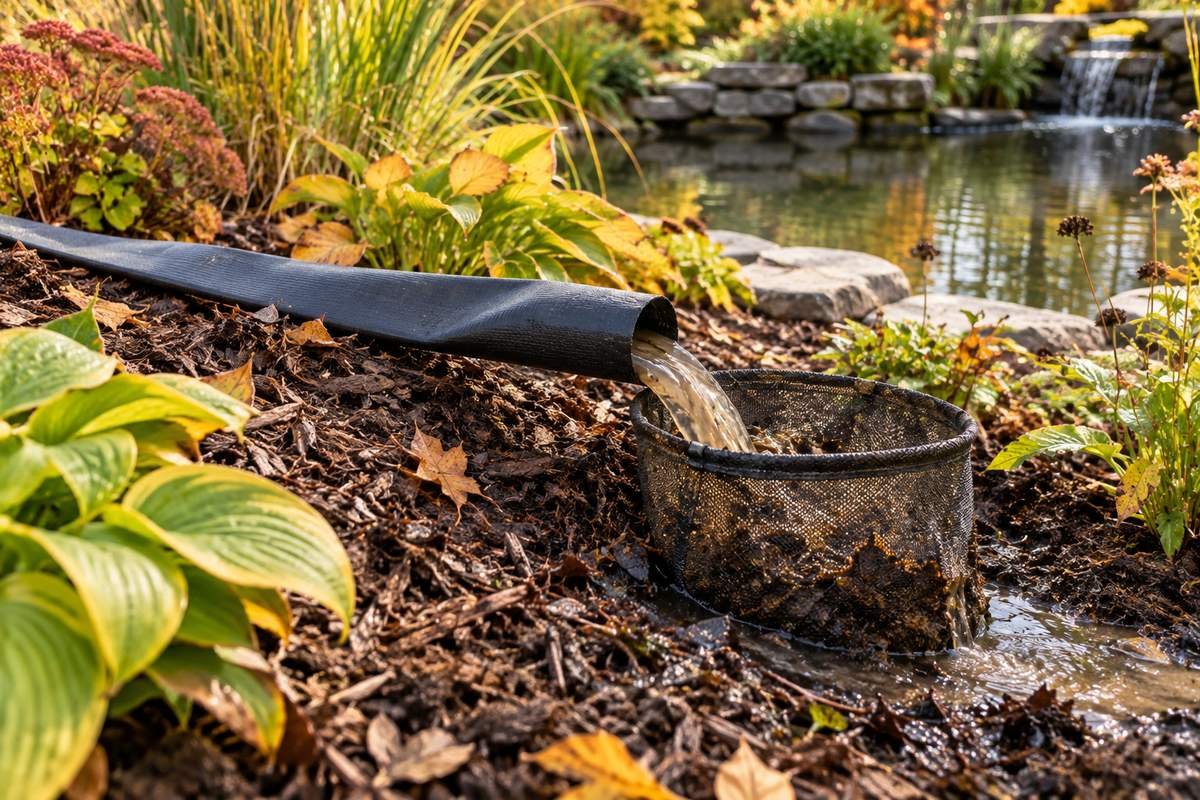
Do not run the discharge hose back into the pond. The water coming out is the dirty water you just removed.
Pond Vacuum Safety
A pond vacuum is an electric motor used next to water, so GFCI protection matters. The U.S. Consumer Product Safety Commission says GFCIs are especially useful where electrical equipment is near water. It also recommends a portable GFCI when you use electric garden equipment. The ClearVac manual says to plug it only into a grounded outlet with GFCI protection.
A GFCI lowers the risk of electric shock, but it does not make damaged equipment safe. It cannot protect you from a cut or crushed cord, a cracked plug, a wet or loose connection, or an extension cord that is not rated for outdoor use. Before each use, check the cord and plug for damage. Follow your vacuum maker’s exact instructions for grounded outlets, outdoor extension cords, cord gauge, and maximum cord length. The ClearVac manual, for example, calls for a grounded outlet with GFCI protection and a 10- or 12-gauge outdoor cord no longer than 50 feet. Other models may have different requirements. If your outdoor outlet has no GFCI protection, have an electrician add it before you use the vacuum.
Unplug the vacuum before clearing a clogged nozzle or emptying a debris bag. Never stand in the pond while the vacuum is plugged in.
When to Vacuum Your Pond
Kansas State University’s water gardening guide suggests removing winter debris from the bottom in spring and netting or skimming leaves in fall. The RHS adds that early autumn is a good time to clean out. For most backyard ponds, that means vacuuming in spring and again in early fall.
In fall, a leaf net over the pond saves a lot of vacuuming later. Our seasonal pond care guide covers netting and the other fall jobs.
Alternatives to a Pond Vacuum
- A leaf net. Keeping leaves out is the easiest way to reduce muck.
- A hand net. A long-handled pond net works for leaves and string algae in a small pond.
- A partial drain and clean-out. For a very deep or very dirty pond, lowering the water, moving fish to a holding tank, and cleaning half the pond at a time can work better than a vacuum.
- Sludge-eating bacteria. These products are sold to break down muck. The evidence is thin. A 2021 lab study at Grand Valley State University found that one brand of muck pellets did not reduce organic matter in lake sediment, even at more than 25 times the label dose. They are not a replacement for removing muck.
If your water is green rather than mucky, read our guide to green pond water. Good pond aeration also helps the pond break down waste on its own.
Quick Answers
Will a pond vacuum suck up my fish?
It can. Small fish are most at risk, but any fish can get hurt if it swims into the nozzle. Keep the nozzle away from fish and move it slowly along the bottom. Before a bigger cleaning, move small or weak fish to a holding tub filled with pond water. When you can, clean only part of the pond at a time so the rest of the pond life is less disturbed.
How deep can a pond vacuum reach?
Most home pond vacuums are rated for about 6 feet. OASE lists the PondoVac 4 at about 7.9 feet, but suction drops past about 6.5 feet. Half Off Ponds recommends 3 feet or less for the CleanSweep 1400. Published ratings vary between maker pages and manuals, so confirm the limit for your exact model.
Where does the dirty water go?
Out the discharge hose. Run it to a garden bed or lawn where the water will not run back into the pond or into a storm drain. The Pond Guy says returning the water can cloud the pond.
How often should I vacuum my pond?
Most ponds need it once or twice a year, often in spring and fall. A pond under trees or with many fish may need it more often. Clean one part of the pond at a time rather than the whole pond at once.
Do I need to add water after vacuuming?
Usually, yes. A vacuum removes pond water along with the muck. Top it up slowly, and treat tap water with a dechlorinator before adding it.
Can I use a shop vac on a pond?
We do not recommend it. The Pond Guy warns that a wet/dry vac will suck up anything in its path, including your fish. Pond vacuums are made for wet sludge and come with long hoses and pond nozzles.