
A pond filter keeps the water clear and safe for fish by trapping dirt and growing helpful bacteria that break down fish waste. The right pond filter depends on three things: your pond’s volume, how many fish live in it, and where you can put the filter.
PondBrief is a participant in the Amazon Services LLC Associates Program, an affiliate advertising program designed to provide a means for sites to earn advertising fees by advertising and linking to Amazon.com. As an Amazon Associate, we earn from qualifying purchases.
This guide explains what a filter does, the six main types, how to size one in three steps, and seven filters worth a look. It also has a quick sizer that does the math for you. We have not tested these filters ourselves. Every rating below comes from the maker’s own product page.
Table of Contents
Do You Need a Pond Filter?
Not always. The Royal Horticultural Society says ponds with few or no fish should not need a filter. A wildlife pond with plenty of plants can stay balanced on its own, because the plants use up the nutrients that feed algae.
Fish change that. Fish waste and leftover food break down into ammonia, which is toxic to fish. A pond with goldfish or koi needs a filter to deal with it, and the more fish you keep, the bigger the filter needs to be.
A filter also helps if your water turns green every summer, if the pond gets full sun, or if leaves blow in. Our guide to green pond water covers the other causes of algae.
What a Pond Filter Does
Most pond filters do two jobs, and many add a third.
- Mechanical filtration traps leaves, dirt, and fish waste in foam pads, mats, or brushes. It keeps the water looking clean, and it keeps debris from clogging the biological part.
- Biological filtration gives helpful bacteria a place to live. They turn ammonia from fish waste into nitrite, then into nitrate, which is far less harmful and which plants use as food. This process helps keep fish healthy.
- UV clarification passes water past an ultraviolet bulb. It clumps the tiny floating algae that turn water green, so the filter can catch them. It does not fix string algae, the long, hair-like kind that grows on rocks.
A filter only cleans the water that a pump pushes through it. That is why the pump and the filter have to be matched. Our guide on what size pond pump you need covers the pump side.
The Main Types of Pond Filters
There are six common types. Most backyard ponds use one of the first four.
Pressurized filters
A pressurized filter is a sealed canister that sits beside the pond. Because it is sealed, it can push water uphill to a waterfall, and it can be partly buried to hide it. Many include a built-in UV bulb and a backflush handle for cleaning. The RHS warns that external pressurized filters should not be used for heavily stocked ponds or ponds with large koi. They suit small and medium ponds with a normal number of fish.
Box or gravity filters
A box filter is an open tank that sits higher than the pond. Water flows in at the top, passes through layers of foam and media, and runs back to the pond by gravity. Box filters usually hold more media than a pressurized filter of the same size, which suits ponds with more fish. They are harder to hide and can’t feed a waterfall above them.
Submersible filters
A submersible filter is a flat foam box that sits on the bottom of the pond, with the pump attached. It is cheap and hidden, and it works well in a small pond or a fountain. It holds little media, so it is mostly a mechanical filter. You also need to pull it out of the water to clean.
Skimmer and waterfall filters

This is a pair. A skimmer sits at the edge of the pond and pulls in floating leaves before they sink. The pump sits inside the skimmer. It sends water to a waterfall filter, often called a BioFalls, at the top of the stream, where bacteria break down pollutants and clean water spills back into the pond. Most pond builders install this setup in new ponds. Skimmers are sized by the pond’s surface area, and waterfall filters by its gallons.
Bead filters
A bead filter is a pressurized tank full of small plastic beads. The beads trap fine dirt and hold bacteria, and you clean them by backwashing, much like a pool filter. Bead filters are mostly used on large koi ponds and cost more than other types.
Bog filters
A bog filter is a shallow bed of gravel planted with bog plants. The pump pushes water up through the gravel, where bacteria and plant roots clean it. Chewy’s pond guide recommends a bog about 10 to 20 percent the size of the main pond. It looks like part of the garden, but it takes room and work to build.
How to Size a Pond Filter
Sizing comes down to three steps.
1. Work out your pond’s gallons. Multiply length by width by average depth, all in feet, then multiply by 7.48. Aquascape uses 7.48 in its own sizing guide. A pond 10 feet long, 8 feet wide, and 2 feet deep on average holds about 1,197 gallons. Our pond calculator does this for odd shapes.
2. Adjust for fish. A filter’s headline number usually assumes no fish. OASE gives each BioPress filter three ratings. On the BioPress 2400, it is 2,400 gallons with no fish, 1,200 with fish, and 600 with koi. The fish figure is half the top rating, and the koi figure is a quarter. So for a goldfish pond, look for a filter rated for at least twice your gallons. For koi, look for four times. Ponds in full sun also need extra room, the RHS notes.
3. Match the pump. Texas A&M AgriLife Extension says the pump should move the whole pond through the filter every 1 to 2 hours. For a 1,200-gallon pond, that’s about 600 to 1,200 gallons per hour (GPH) at the height it has to lift. Never use a pump that pushes more than the filter’s maximum flow. Aquascape warns that too much flow can cause waterfall filters to spill over the sides.
Read more in the Texas A and M AgriLife water garden guide.
Pond Filter Sizer
Enter your pond’s size and the fish it holds. The sizer calculates the gallons, the filter rating to look for, the pump flow range, and which filters below fit.
Pond filter sizer
Use feet. For an odd shape, use the average length, width and depth.
Ratings come from each maker. Fish and koi figures for filters with one rating use the OASE split (half for fish, a quarter for koi). Full sun or heavy feeding needs a bigger filter.
Pond filter sizer by PondBriefpondbrief.com
7 Pond Filters Worth a Look
These cover each common type, from a small fountain to a pond builder’s skimmer and waterfall setup. The order follows pond size, not a ranking.
Best for small fish ponds
OASE BioPress 1600

The BioPress 1600 is a pressurized filter with a built-in 9 watt UV bulb. OASE rates it for ponds up to 1,600 gallons with a light fish load, 800 gallons with a medium load, and 400 gallons with a heavy load such as koi. That makes it a good match for a small backyard pond with a few goldfish.
It has a cleaning handle for backflushing, so you can rinse the foams without opening the lid. OASE says it can feed a waterfall up to 7 feet higher than the filter. It lists a maximum flow of 2,000 GPH, so a pump of about 400 to 800 GPH suits an 800 gallon fish pond.
- Type: Pressurized, with UV
- Pond size: 1,600 gallons light fish load, 800 medium, 400 heavy
- Maximum flow: 2,000 GPH
- UV: 9 watts
- Connections: 3/4, 1, 1 1/4 and 1 1/2 inch
- Warranty: 2 years
A size up for fish ponds
OASE BioPress 2400

The BioPress 2400 is the next size up. OASE rates it for 2,400 gallons with no fish, 1,200 gallons with fish, and 600 gallons with koi. It also has a 9 watt UV bulb and the same backflush handle.
OASE lists a maximum flow of 2,120 GPH. It comes with two blue and two black foams, biological media and step fittings for different hose sizes.
- Type: Pressurized, with UV
- Pond size: 2,400 gallons no fish, 1,200 with fish, 600 with koi
- Maximum flow: 2,120 GPH
- UV: 9 watts
- Connections: 3/4 to 1 1/2 inch
- Warranty: 2 years, limited
Best pressurized filter for bigger ponds
Aquascape UltraKlean 3500

The UltraKlean 3500 is a larger pressurized filter with a 28 watt UV bulb. Aquascape lists it for an average pond size of 3,500 gallons and a maximum flow of 5,200 GPH. It has a 20 foot cord, which helps when the outlet is far from the pond.
Aquascape does not give a separate rating for fish. Using the half and quarter rule above, plan on about 1,750 gallons with goldfish and about 875 with koi.
- Type: Pressurized, with UV
- Pond size: 3,500 gallons (no fish rating listed)
- Maximum flow: 5,200 GPH
- UV: 28 watts
- Discharge: 1, 1 1/4 or 1 1/2 inch hose
- Warranty: 3 years, limited
Best simple pressurized filter without UV
TetraPond Bio-Active Pressure Filter 2500

The Tetra Bio-Active Pressure Filter uses open plastic bio-activators that trap dirt and give bacteria a large surface to grow on. Tetra rates it for ponds up to 2,500 gallons. It has a backflush valve, so you can clean it by removing a cap instead of opening the filter.
It has no UV bulb, so it will not clear green water on its own. Tetra does not list a maximum flow or a fish rating. By the half rule, treat it as about a 1,250 gallon filter for a goldfish pond.
- Type: Pressurized, no UV
- Pond size: Up to 2,500 gallons (no fish rating listed)
- Maximum flow: Not listed
- Cleaning: Backflush valve
- UV: None
Best skimmer for small and medium ponds
Aquascape Signature Series 400 Pond Skimmer

A skimmer is the first half of a skimmer and waterfall setup. The Signature 400 pulls floating leaves into a basket before they sink, and the pump sits inside it, out of sight. Aquascape sizes it by surface area: up to 400 square feet of pond, with a maximum flow of 4,000 GPH.
It comes with a faux rock lid, a debris basket, a filter mat, a weir door and a faceplate. Pair it with a waterfall filter such as the BioFalls below.
- Type: Skimmer
- Pond size: Up to 400 square feet of surface
- Maximum flow: 4,000 GPH
- Includes: Lid, basket, filter mat, weir door, faceplate
- Warranty: Limited lifetime
Best waterfall filter
Aquascape Signature Series 2500 BioFalls

The BioFalls sits at the top of a stream or waterfall. Water from the skimmer’s pump rises through filter mats and media, where the bacteria live, then spills out of the front into the pond. Aquascape rates the 2500 for ponds up to 2,500 gallons, with a maximum flow of 5,000 GPH.
Aquascape says to clean the BioFalls mats only once a year, during the spring cleanout, because cleaning them mid-season kills the helpful bacteria. If your pond is smaller, the 1000 BioFalls is rated for 1,000 gallons.
- Type: Waterfall (BioFalls)
- Pond size: Up to 2,500 gallons
- Maximum flow: 5,000 GPH
- Cleaning: Once a year, in spring
- Pair with: A skimmer and its pump
Best for small ponds and fountains
TetraPond Submersible Flat Box Filter
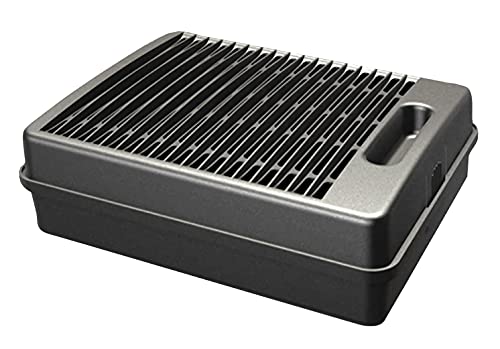
The Flat Box is a foam filter that sits on the pond bottom and attaches to the pump intake. It keeps the pump and fountain heads from clogging, and it clears floating dirt in a small pond. Tetra says it fits pumps from 200 to 2,000 GPH.
It comes with coarse and fine foam pads, 1 inch tubing and three fittings for different pumps. It holds little biological media, so pair it with plants or a bigger filter if you keep fish.
- Type: Submersible
- Fits pumps: 200 to 2,000 GPH
- Includes: Coarse and fine pads, 1 inch tubing, 3 fittings
- UV: None
- Warranty: 1 year, limited
Also consider: the TetraPond Filtration Fountain Kit for a tub pond or patio water garden. It pairs a flat box filter with three fountain heads, and Tetra sells it in sizes up to 100, 50 to 250, and 250 to 500 gallons. It has a 3-year limited warranty.
Pond Filters Compared
Swipe the table sideways on a phone to see every column.
| Filter | Type | Top rating (gallons) | Fish rating | Koi or heavy load | Max flow (GPH) | UV |
|---|---|---|---|---|---|---|
| OASE BioPress 1600 | Pressurized | 1,600 | 800 | 400 | 2,000 | 9 W |
| OASE BioPress 2400 | Pressurized | 2,400 | 1,200 | 600 | 2,120 | 9 W |
| Aquascape UltraKlean 3500 | Pressurized | 3,500 | Not listed | Not listed | 5,200 | 28 W |
| TetraPond Bio-Active 2500 | Pressurized | 2,500 | Not listed | Not listed | Not listed | None |
| Aquascape Signature 400 Skimmer | Skimmer | 400 sq ft surface | Not listed | Not listed | 4,000 | None |
| Aquascape Signature 2500 BioFalls | Waterfall | 2,500 | Not listed | Not listed | 5,000 | None |
| TetraPond Flat Box | Submersible | Not listed | Not listed | Not listed | Pumps 200 to 2,000 | None |
Setting Up a New Pond Filter
A new filter cleans dirt from day one, but the biological part takes time. The RHS says the bacteria take about six weeks to build up. During that time, add fish slowly and feed lightly. A pond water test kit shows when ammonia and nitrite drop to zero, which means the filter is working.
Keep the filter running. The RHS warns that the bacteria can die if you switch off the filter for 24 hours or more. If you add bottled bacteria to speed things up, OASE says to follow the label and turn off your UV clarifier before you add them.
Place a pressurized filter where you can reach the lid and the cleaning handle. Run the waterfall filter level so water spills out the front, not over the sides.
How to Clean a Pond Filter Without Losing the Good Bacteria
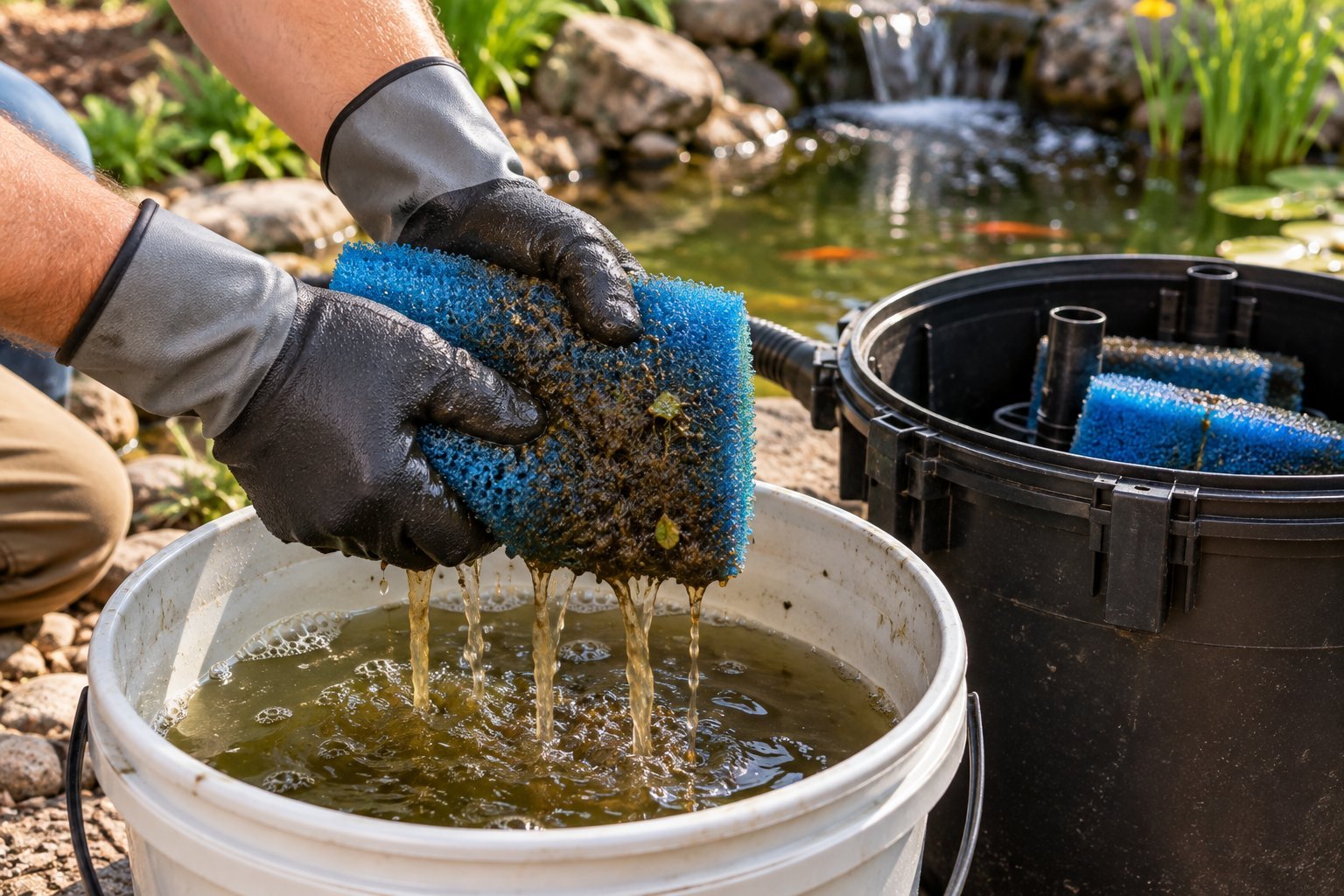
The goal is to clear the dirt but leave most of the bacteria in place. A filter scrubbed spotless has to start its six-week cycle over.
- Pressurized filters: use the backflush handle or valve when the flow drops or the filter shows it needs cleaning. That rinses the foams without opening the lid.
- Waterfall filters: Aquascape says to clean BioFalls mats once a year, in the spring cleanout. Cleaning them mid-season kills off the bacteria and, in its words, basically restarts the pond.
- Skimmers: empty the debris basket often, weekly in fall. Rinse the skimmer mat when it clogs.
- Rinsing by hand: squeeze foams in a bucket of pond water rather than under the tap. Many towns treat tap water with chlorine or chloramine to kill germs, and the bacteria in your filter are germs too.
- UV bulbs: Tetra says to replace a UV bulb every two seasons, or every 11 months, even if it still glows.
Muck on the pond floor is a separate job. Our pond vacuum guide covers how to remove it.
Pond Filters in Winter
In mild areas, keep the pump and filter running all year. Aquascape says that in cold areas you can either keep the pump running, which helps keep a hole open in the ice for gas exchange, or pull the pump and store it indoors. In very cold weather, it suggests adding a floating de-icer. Our pond heater vs de-icer guide shows what size to buy.
If you shut a filter down for winter, drain it to prevent cracking, then store the UV unit indoors. Expect the bacteria to rebuild from scratch in spring. Our seasonal pond care guide and pond aeration guide cover the rest of winter care.
Common Pond Filter Mistakes
- Buying a no-fish rating filter for a pond full of fish.
- Using a pump that pushes more than the filter can handle.
- Cleaning the filter media in tap water, or scrubbing it spotless.
- Switching the filter off at night to save power.
- Expecting a UV clarifier to clear string algae. For that, see our guide to barley straw for ponds.
- Putting a small pressurized filter on a crowded koi pond.
Quick Answers
What size pond filter do I need?
Work out your gallons (length times width times average depth in feet, times 7.48). For a pond with no fish, a filter rated for those gallons is enough. With goldfish, choose one rated for at least twice your gallons. With koi, choose four times. That follows the split OASE prints on its BioPress filters.
Do I need a pond filter if I have no fish?
Often not. The Royal Horticultural Society says ponds with few or no fish should not need a filter. Plenty of plants and some shade usually keep a wildlife pond clear.
How often should a pond filter run?
All the time, day and night. The RHS warns that the helpful bacteria can die if the filter is off for 24 hours or more.
How often should I clean my pond filter?
Only when it clogs or the flow drops. Use the backflush on a pressurized filter. Aquascape says to clean BioFalls mats just once a year, in spring.
Does a pond filter remove green water?
A filter with a UV clarifier does. The UV clumps the floating algae so the filter can catch them. A filter without UV traps dirt but may not clear green water on its own.
What pump size goes with my filter?
Texas A&M AgriLife Extension says the pump should move the whole pond through the filter every 1 to 2 hours. Keep the pump flow under the filter’s maximum.