
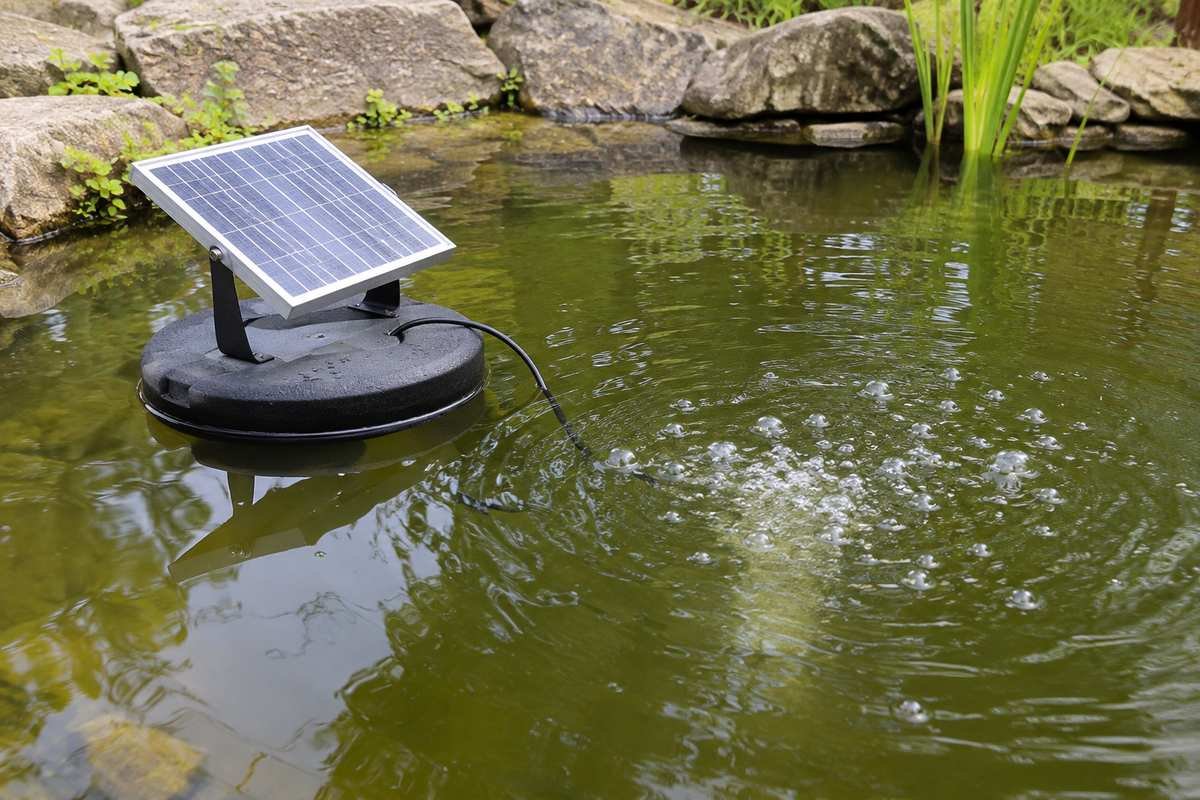
A pond without power nearby still needs oxygen — and that is the whole case for a solar pond aerator. It runs on sunlight instead of an outlet, which sounds like a simple swap, but it isn’t quite that simple. The tricky part is timing: a pond usually needs the most oxygen right before dawn, which is exactly when a plain solar unit has the least power left. Getting a solar pond aerator that actually helps your pond means understanding that gap and buying around it, not just picking whichever bubbler has the most watts on the box.
This guide covers how solar aerators work, the difference between a direct-drive unit and one with battery backup, how to size one to your pond, and what to expect at each price point. For the basics on why ponds need aeration at all — including the kit finder and running-cost comparison — see our guide to pond aeration. This one picks up where that one leaves off: the solar-specific tradeoffs.
Table of Contents
How a solar pond aerator works
Every solar pond aerator has the same four parts: a solar panel, an air pump, a length of airline tubing, and a diffuser or air stone that sits near the pond bottom (see the installation section below for why “near” rather than flush on the bottom matters). The panel converts sunlight into electricity, and that electricity either runs the pump directly or charges a small battery first, which then runs the pump. The pump pushes air down the tubing to the diffuser, where it breaks into bubbles. As those bubbles rise, they bring water up from the bottom and let it pick up oxygen at the surface — the same basic job an electric air pump does.
The panel itself works the same way as any residential solar setup, converting sunlight directly into electricity, a process the U.S. Department of Energy covers in more detail.
The panel and pump are usually a fixed pair sold as one kit, so you aren’t choosing components separately the way you might with a full electric aeration system. What you’re choosing is the size of that pair, and whether a battery sits between them.
Direct-drive vs. battery backup: which one you need
Solar pond aerators come in two basic types, and the difference matters more than brand or price.
Direct-drive units have no battery. The pump runs only while the panel is getting direct sun, and it slows down — or stops — as clouds roll in, shutting off completely at dusk. These are the cheapest units, often under $25, and they’re fine for a small decorative pond, a stock tank, or a container pond where fish aren’t packed in tightly and a few hours of daytime aeration is enough.
Battery-backup units store extra daytime power in a built-in battery, usually in the 2,200 to 4,400 mAh range for small residential units, and use it to keep the pump running after dark or through a cloudy stretch. This is the type worth paying more for if you keep koi or a heavier fish load, since those ponds need steadier oxygen than a few sunny hours can provide.
That battery gap is the real reason to care about this choice. Pond oxygen is usually lowest in the hour or two before sunrise — after a full night of fish and algae using it up with nothing replacing it. A direct-drive aerator has been off for hours by then; a battery unit, sized correctly, is still running. If your pond has any real fish load, treat battery backup as the baseline, not an upgrade.
Sizing a solar aerator to your pond
Solar pond aerators are built for small to medium ponds — roughly up to a few thousand gallons — not for backyard lakes. Specs on the box are usually listed as liters per minute (L/min) or as watts, and neither tells you much by itself: a panel’s wattage mostly affects how fast the battery recharges, not how much air reaches the water, and the L/min figure on most small units is a free-air rating, not what actually survives the trip down to a diffuser sitting under several feet of water.
The roughly-1-CFM-per-1,000-gallons rule many pond suppliers quote (1.5 to 2 CFM per 1,000 gallons for a heavily stocked koi pond, warm water, or a pond with little wind or surface movement) is an industry and hobbyist convention, not a figure from the aquaculture research literature — worth saying plainly, since it’s often presented as settled science. University extension guidance for pond aeration (University of Maryland Extension’s pond aeration guide) sizes larger ponds in horsepower per surface acre instead — roughly 1 to 2 hp per acre for intensively stocked commercial ponds, less for lightly stocked recreational ponds, with no single number given. That acre-based approach doesn’t translate cleanly to a small backyard pond measured in gallons, which is why the gallon-based convention persists for this size of pond despite not coming from the same source. Treat it as a starting point to size around, not a formula that replaces judgment: it says nothing on its own about your pond’s depth, how much resistance your specific diffuser adds, how heavily it’s stocked, or water temperature, all of which change how much air you actually need.
To compare a CFM figure against a small solar unit’s L/min rating, convert: 1 CFM is about 28.3 L/min. A typical small solar aerator putting out 0.6 to 0.8 L/min works out to roughly 0.02 to 0.03 CFM — enough for a container pond or a modest water feature of a few hundred gallons at most under the convention above, not something you can scale up to a real fish pond just by buying a bigger panel. That L/min number is also usually a free-air rating, measured with no resistance on the pump — not what makes it through tubing and a diffuser sitting on the pond bottom under real water pressure. The same University of Maryland guidance notes that many aerators mix effectively only to about five feet of depth, and that diffused-air systems generally shouldn’t sit directly on the pond bottom at all, since that can stir up sediment and release nutrients rather than just adding oxygen — worth knowing before you assume “weight it down on the bottom” is correct for every pond (see the installation section below for how we’ve adjusted that guidance).
Depth, diffuser resistance, water temperature, and stocking density all cut into how much of that air actually raises dissolved oxygen (DO) where the fish are, and bubbles breaking the surface are not proof that DO is adequate. University of Florida IFAS Extension puts optimal fish health at 5 mg/L DO or higher, calls most species distressed in the 2–4 mg/L range, and notes mortality typically occurs below 2 mg/L. DO also runs on a daily cycle — it rises while plants and algae photosynthesize in daylight and falls overnight, usually bottoming out right before dawn, per the same source. A basic DO test kit or meter is the only way to know where your pond actually sits, and fish gasping at the surface or crowding near an aerator are signs of trouble that call for action right away, not a wait-and-see approach.
Once you get into the low thousands of gallons — especially with koi — you’re generally better served by an 8 to 15 watt unit with a larger battery and, often, two diffusers instead of one, or by a plug-in electric aerator with a dependable power supply.
Our pond aeration kit finder is a useful starting point for comparing running cost between electric options, though it isn’t built to run solar-specific CFM math — for that, use the per-1,000-gallon guideline above, then confirm with a DO test once the unit is running.
Worked example: how much battery runtime do you actually get?
Take a mid-size unit as an example: an 8-watt solar panel and a 4,400 mAh / 3.7V lithium battery (16.28 Wh nominal capacity — the nameplate figure from the battery’s rated mAh × voltage). None of the three products in our comparison table above discloses pump wattage or the battery’s discharge circuitry, so rather than one falsely-precise number, this works out a realistic range from standard assumptions for small lithium-ion consumer electronics. Every assumption is stated so you can substitute your own unit’s numbers if its manufacturer publishes them.
Assumptions used:
- Usable battery capacity: consumer lithium-ion packs are rarely cycled to full depletion — a battery-management circuit typically reserves 10–20% to protect cycle life — so usable capacity is taken as 80–90% of the 16.28 Wh nominal figure: 13.0–14.65 Wh.
- Discharge-path losses: getting stored energy to the pump usually passes through a small DC-DC converter or regulator, typically 85–95% efficient for this class of device, leaving 11.1–13.9 Wh actually available to run the pump.
- Pump draw: not disclosed for any of our three compared products; a 1–2W range is used, consistent with pumps in similarly sized aerators.
- Solar charging: 4–5.5 peak sun hours (a typical range across most of the continental US) and 65–80% combined charging and conversion efficiency, accounting for panel angle, imperfect sun tracking, and charge-controller losses.
Runtime on stored battery alone: 11.1 Wh ÷ 2W ≈ 5.5 hours on the conservative end, up to 13.9 Wh ÷ 1W ≈ 13.9 hours on the optimistic end — call it roughly 5.5 to 14 hours on a full charge, assuming the battery started the night full. That’s a wide range on purpose: it reflects real uncertainty in pump draw and converter efficiency that no manufacturer in our comparison table discloses, not imprecision in the arithmetic.
Estimated daily charging energy: an 8W panel across 4 to 5.5 peak sun hours at 65–80% efficiency delivers roughly 8W × 4h × 0.65 ≈ 21 Wh to 8W × 5.5h × 0.80 ≈ 35 Wh per day at the battery’s input — on most days enough to refill a 13–14.65 Wh usable capacity, though a short, overcast winter day can fall short of the low end of that range.
Treat every number here as an estimate, not a guarantee: cloud cover, panel angle, shade, battery age, and the actual — undisclosed — pump draw and converter efficiency of whatever unit you buy will all move these figures, sometimes significantly. An interactive version of this calculator, where you could plug in your own panel, pump, and battery numbers, isn’t built yet; this worked example, with every assumption stated above, is the stand-in until it is.
Solar pond aerator vs. electric: which should you pick?
A solar pond aerator wins on installation. There’s no trench to dig, no outlet to run, and nothing to plug in near standing water, which matters most for a pond set away from the house or in a yard with no outdoor power at all. A solar pond aerator also costs nothing to run once you’ve bought it, since the sun is free.
An electric aerator wins on reliability. It runs at full, steady output day and night, in any weather, without depending on a battery that fades with age or a few cloudy days in a row. For a pond with a heavy koi load, or anywhere aeration genuinely can’t lapse, a plug-in electric unit is still the safer choice, with a solar pond aerator better suited as a supplement or as the main system for a lighter-stocked pond.
Cost over time narrows the gap less than people expect. A small electric air pump usually runs for just a few dollars a year in most areas, so a solar pond aerator’s “free” power rarely pays for itself quickly against the price difference between the two. Pick solar for the convenience of skipping an outlet, not primarily to save on electricity.
Does a solar aerator work in winter?
Short days and weak winter sun cut straight into a solar pond aerator’s output, right when a pond with fish in it still needs an open spot in the ice. A direct-drive unit, already limited to daylight hours, loses even more of its working day in December and January. A battery-backup unit holds up better, but a battery that was sized for a long summer day of charging may not fully top off on a short, overcast winter one.
If keeping an ice hole open through a real winter matters for your climate and your fish, a plug-in electric aerator or a dedicated de-icer is the more dependable tool for that specific job — see our pond heater vs. de-icer guide for how to choose between them. A solar pond aerator works well most of the year, and it struggles most exactly when the days get shortest, so check our broader seasonal pond care guide for what else your pond needs as water temperatures drop — worth knowing before you count on solar alone as your only line of defense in January.
What to check before you buy
Run through this list before you buy a solar pond aerator.
- Battery capacity, not just panel wattage. Two units with the same panel size can run very differently overnight, depending on whether the battery is 2,200 mAh or 4,400 mAh.
- Air output in L/min, matched to your gallons. A bigger panel doesn’t always mean more air reaches the water; check the pump’s rated output, not just the watts.
- Waterproof rating. Look for an IP65 rating or better on the pump housing, since it sits outdoors in all weather.
- Number of outlets or diffusers. A single air stone is enough for a small pond. Larger or irregularly shaped ponds often do better with two diffuser points instead of one.
- Mounting method. Some units float on the surface, others mount on a stake or bracket near the bank — floating units can drift into weeds or shallows if the pond has any current or wind.
Most of these checks matter more as your pond gets bigger or your fish load gets heavier. For a small container pond, almost any solar pond aerator on the list above will do the job; for a stocked koi pond, battery capacity and air output are worth the extra research before you buy.
What’s out there at each size
Solar pond aerators fall into roughly three tiers.
Small, budget units typically use a 2 to 3 watt panel with a built-in battery around 2,200 mAh, a single air stone, and a claimed noise level under 60 decibels. Current listings for this tier span a wide range — generic unbranded units start around $15, while better-documented, named-brand units can run into the $90s — so price alone isn’t a reliable sorting signal here; see the comparison below. These suit container ponds, bird baths, and small water features where a few hours of aeration a day is plenty.
Mid-size units step up to an 8 to 15 watt panel with a larger battery, commonly 4,400 mAh, and often add multiple output modes, such as a strong-bubble setting and a gentler cycle mode. As of late 2026, verified current listings for this tier run closer to $70–$95 than the $30–$50 figure some older buying guides still quote. These are the better fit for a few hundred to a couple thousand gallons with a real fish load.
Three currently obtainable solar pond aerators, compared
Verified against live Amazon listings on 23 Nov 2026. The three units compared here replace an earlier version of this table that used Walmart-, manufacturer-direct-, and Home-Depot-exclusive listings; these three are all sold on Amazon with an established review history, so every card below has a real photo and a working buy button.
Best for a small pond on a budget
Srygery 4W Solar Pond Aerator

A straightforward small-pond unit with a long run of real Amazon reviews behind it, which is useful in a category full of thin, unreviewed listings. The manufacturer’s longest runtime claim is for the lowest-output interval mode and isn’t a figure we tested ourselves.
- Panel: 4W
- Battery: 2,200 mAh Li-ion
- Air output: up to 0.8 L/min, with a strong-bubble, soft-bubble, and 10-second-on/10-second-off interval mode
- Reviews: 4.1 stars across 379 ratings on Amazon as of this check
Best for a bit more battery headroom
Biling 8W Solar Pond Aerator (ZY080A)

Roughly double the panel wattage and battery capacity of the pick above, for a pond that needs more reserve than a 4W unit can provide. It carried Amazon’s Choice for this category as of this check.
- Panel: 8W
- Battery: 4,400 mAh
- Air output: 3 adjustable bubble modes
- Warranty: 60-day money-back window plus a 1-year limited warranty, per the manufacturer
- Status: carried Amazon’s Choice for this category at last check, with 145 ratings
Best for the highest rated airflow
15W Solar Pond Aerator with 4,400 mAh Battery Backup (OELFFOW)

The highest-output unit of the three and the most detailed spec sheet of any listing we checked in this category, but it’s a newer listing with only a single Amazon review as of this check, so treat the manufacturer’s runtime figures as unverified by outside reviewers until more reviews accumulate.
- Panel: 15W, 10V
- Battery: 4,400 mAh, 7.4V
- Air output: 3 modes, High rated at 2.5 L/min (about 22 hours on battery), Low at 0.5 L/min (about 55 hours), and a 10-second-on/10-second-off interval mode (about 110 hours)
- Max rated depth: about 1 meter (3.3 ft)
- Build: ABS housing with aluminum-alloy components
All three ASINs and the specs above were cross-checked against the live Amazon listing (or, where Amazon’s own bot-check blocked a direct reload, against multiple independent third-party sources citing the same ASIN and spec sheet) on 23 Nov 2026.
Evidence gap: a fourth listing was checked and excluded from this table. It showed an unexplained “$150.00 sale price” struck through next to an $88.88 “regular” price, named no manufacturer or model number, and disclosed no panel wattage or diffuser count — it didn’t clear the bar for inclusion. More broadly, this product category is dominated by near-identical, likely-rebranded listings that reuse the same 0.6–0.8 L/min output figure across panels ranging from 2.5W to 15W, which looks like a stock marketing number rather than a per-unit measurement in at least some cases. Treat any single listing’s output claim with that in mind, and recheck current pricing before buying — these listings change often.
Larger, dedicated solar aeration systems exist for bigger ponds and small lakes, built with a standalone compressor cabinet and a separate solar array rather than a floating all-in-one unit. These cost considerably more than the consumer kits above, and they’re a different purchase entirely — closer to a scaled-down version of the electric compressor systems used on farm ponds. If your pond is heading into that size range, it’s worth pricing a conventional electric aerator alongside any solar option, since the running-cost difference shrinks as the equipment gets bigger.
Installing and maintaining it
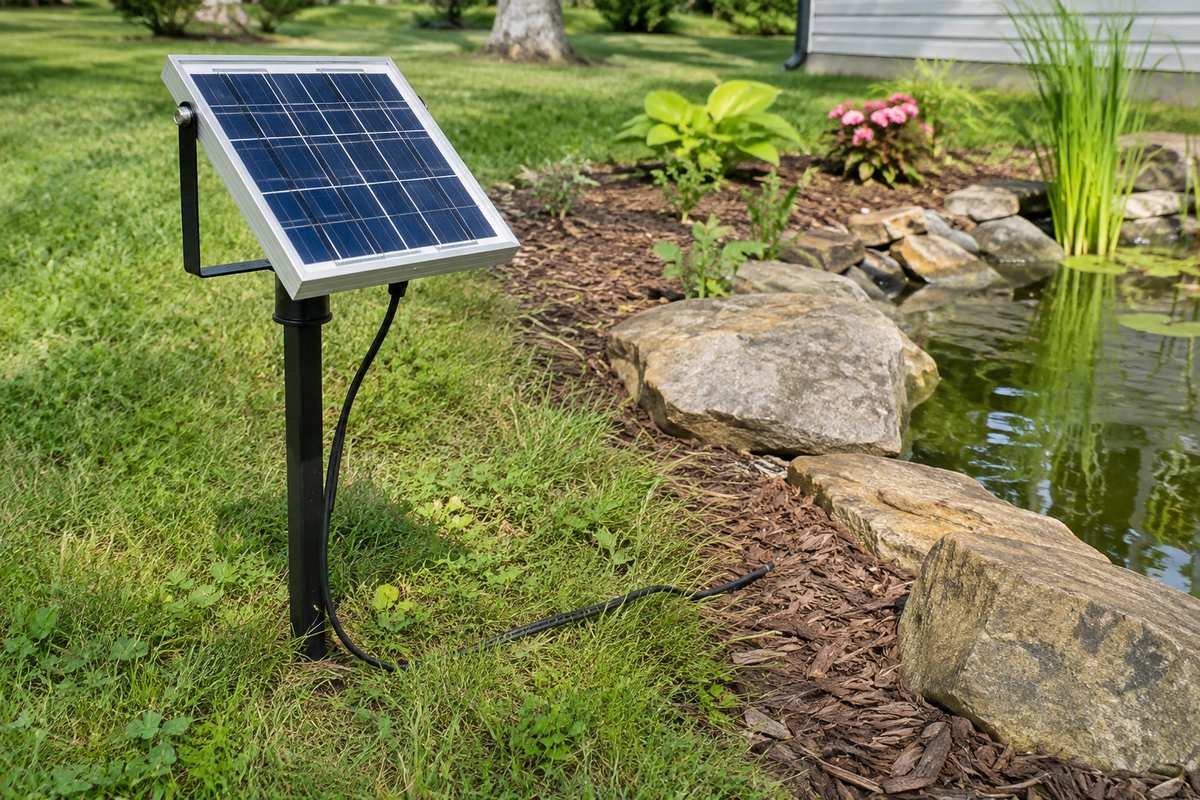
Place the solar panel somewhere it gets direct sun for most of the day, away from trees or buildings that will shade it by afternoon. The panel doesn’t need to sit at the pond’s edge — most kits include enough cable to mount it several feet away on a post, fence, or roofline, which matters if the sunniest spot and the pond’s edge aren’t the same place.
Run the airline tubing to the diffuser, and place it in the deepest part of the pond — but only from spring through fall, when you want full circulation for a given amount of air. Rather than letting it rest flush on the substrate, mount it slightly above the bottom on a small stand, tray, or a short length of riser tubing if your kit allows it; University of Maryland Extension’s pond aeration guidance notes that diffused-air systems generally shouldn’t sit directly on the bottom, since that can stir up sediment and release nutrients instead of just adding oxygen. If your pump or controller’s manual calls for a check valve in the line, install one oriented so air flows toward the diffuser and pond water can’t siphon back into the pump housing; not every small kit needs one, so check the manual rather than assuming. Check the air stone every few weeks, since diffusers in ponds with algae or heavy biological matter can clog over time and lose output gradually rather than failing outright. If bubbles that used to come up strong start looking weak and scattered, that’s usually the diffuser, not the pump.
In winter, move the diffuser. Leaving it on the bottom year-round can stir up the relatively warmer water fish rely on as a cold-weather refuge, which several pond-care sources specifically warn against. Before ice sets in, raise the diffuser to roughly half the pond’s depth — or near the surface in a shallow pond — so it keeps an opening in the ice without disturbing that deeper warm layer.
How long do they last, and are they worth it?
Most consumer solar pond aerators are built to last 2 to 4 years with regular use, with the battery usually the first part to wear out. A lithium battery that charges and drains daily loses capacity over time, the same way a phone battery does, so a unit running at full output in its first summer may noticeably slow down by its third. Many manufacturers rate their solar panel separately at 10 years or more, but the battery and pump inside the housing are the parts that actually limit the unit’s working life. These figures reflect general consumer-electronics wear patterns rather than a tested lifespan for any specific model — one of the units in this guide’s comparison table (the Biling 8W ZY080A) backs a 1-year limited warranty, consistent with the “90 days to a year” figure below, but we found no manufacturer publishing a tested multi-year lifespan number for a small solar pond aerator.
Warranty coverage on budget units is typically just 90 days to a year, and few sellers offer replacement batteries separately, so a failed battery often means replacing the whole unit rather than a single part. Weigh that against the running cost: a solar pond aerator has no electricity bill at all, while even a small electric air pump costs only a few dollars a year to run in most areas. The real case for solar isn’t the savings on power, since that’s already small either way, but the ability to aerate a pond with no outlet anywhere nearby.
Common questions
Can a solar pond aerator run a fountain or waterfall too?
No. Solar pond aerator kits are built to drive an air pump and diffuser, not a water pump. A fountain or waterfall needs a separate solar or electric water pump sized for its own flow rate. You can run both in the same pond, but they’re two different pieces of equipment.
Will it still work on a cloudy day?
A direct-drive unit slows down noticeably, and may stop producing meaningful airflow on a heavily overcast day. A battery-backup unit draws on its stored charge and keeps running, though at reduced capacity if several cloudy days happen in a row without a full recharge.
Is a solar pond aerator enough on its own, or do I need a waterfall or fountain too?
It can be, but only if it’s actually sized correctly for your gallons and fish load — see the sizing section above — and ideally has battery backup if you keep more than a token number of fish. A lightly stocked decorative pond can often get by on a correctly sized solar unit alone; a stocked koi pond generally can’t on a small direct-drive unit, regardless of brand. A waterfall or fountain adds surface agitation and looks nice, but it’s not a substitute for a dedicated air pump moving water from the bottom up — which our aeration guide covers in more detail.
Do solar aerators need to run 24 hours a day?
Fish benefit most from aeration overnight and in the hours before dawn, when oxygen is naturally lowest — so continuous operation is the goal if your pond carries any real fish load. This is the main reason battery backup matters more than panel size for anyone past a small decorative pond.
Can I replace just the battery when it wears out?
On most consumer solar pond aerators, no. The battery is usually sealed inside the float or housing rather than sold as a separate part, so a battery that no longer holds a charge typically means replacing the whole unit rather than swapping one component.
Do I need a timer or controller to run a solar pond aerator?
No. A solar pond aerator’s panel and battery already handle the on-off cycle automatically, running on daylight and stored charge without any separate controller. A timer only comes into play if you’re pairing the aerator with a plug-in electric backup for extra reliability.
What’s the best time of year to install a solar pond aerator?
Early spring, before warm weather drives oxygen demand up, is the easiest time to install and test a solar pond aerator, since you can watch it run for weeks before fish or algae put any real strain on the pond. That said, a solar pond aerator can go in at any time of year; just expect weaker output right after an install made during a short, overcast stretch of winter.