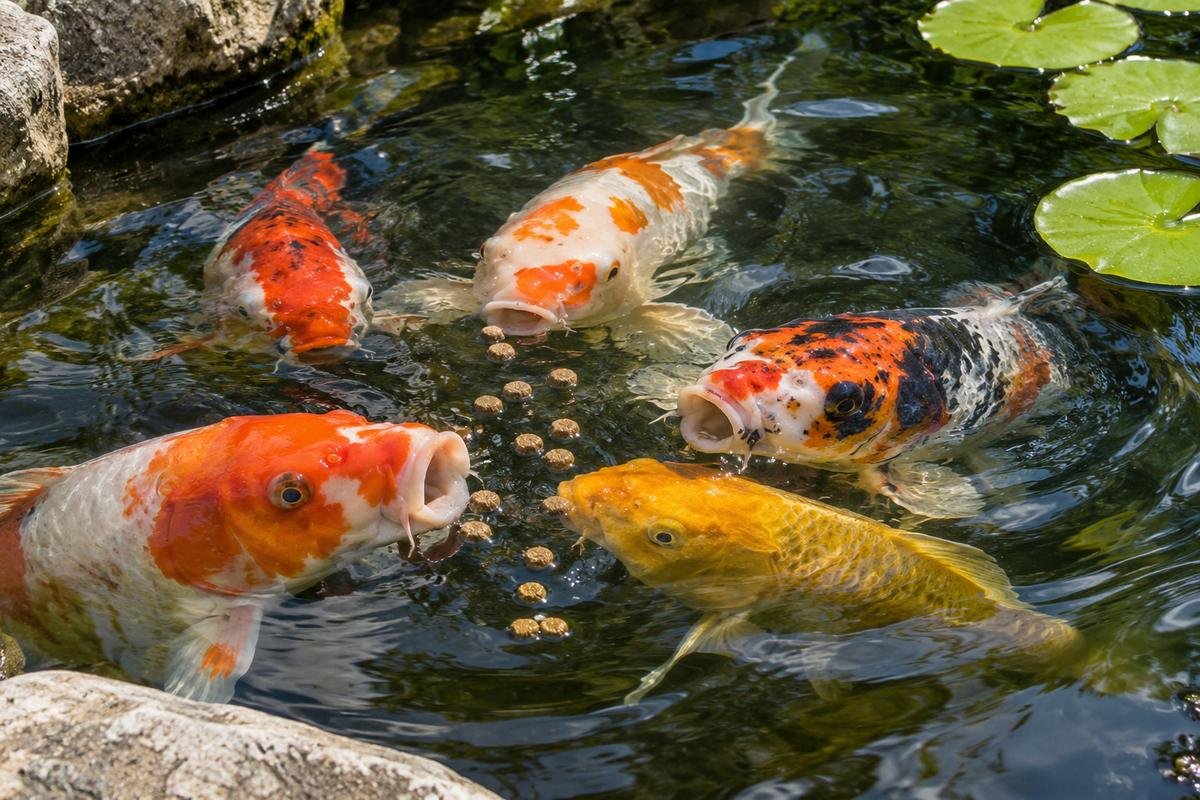
Koi do best on a floating staple pellet fed based on water temperature, not the calendar. Feed only what they finish in about five minutes, a few times a day in summer and less as the water cools. Switch to an easy-to-digest cold water food around 60°F, and stop feeding when the pond stays below about 50°F. Most problems with koi food come from feeding too much, not from picking the wrong brand.
PondBrief is a participant in the Amazon Services LLC Associates Program, an affiliate advertising program designed to provide a means for sites to earn advertising fees by advertising and linking to Amazon.com. As an Amazon Associate, we earn from qualifying purchases.
This guide covers what koi eat, the main types of koi food, a feeding chart by water temperature, and how to work out how much to feed in real numbers. It also has a free feeding calculator, five foods worth a look, and help for vacations, new ponds, and koi that stop eating. We have not tested these foods ourselves. Feeding advice comes from university extension services, a fish veterinarian, and the food makers, named in each section. Product details come from the makers and their Amazon listings.
Table of Contents
What Do Koi Fish Eat?
Koi are a fancy form of the common carp, and like carp, they eat almost anything they can fit in their mouths. In a pond, their natural food includes plankton, floating plants, the fine roots of pond plants, insect larvae, worms, and other small animals, according to Tropical Fish Hobbyist magazine. They also graze on algae and dig through gravel and plant pots looking for food.
That natural food is rarely enough on its own. The same article notes that it is not always plentiful year-round, which is why pond keepers feed prepared food. A complete koi pellet supplies the protein, fat, vitamins, and minerals that a pond cannot supply in steady amounts.
A few things set koi apart from most pets:
- They have no acid stomach. A University of Florida extension veterinarian notes that koi and other carp lack an acid-producing stomach, so their digestion works differently from ours and from most pets.
- Their bodies run at the temperature of the water. In warm water, they digest fast and want to eat often. In cold water, digestion slows to a crawl, and food can sit in the gut.
- They will beg even when they do not need food. Koi learn to rush to the edge when you walk up. That is habit, not hunger, and it leads many owners to overfeed.
Does a lightly stocked pond need feeding at all? A pond with a few small fish, lots of plants, and no filter can sometimes get by on natural food, as our pond fish guide notes. Koi are different. They grow large, and a pond built for koi almost always needs prepared food for them to stay in good shape.
Types of Koi Food and What the Labels Mean
Koi food bags use words like staple, wheat germ, growth, and color. These are not legal standards, so the guaranteed analysis on the back of the bag is the part to trust. It lists the minimum protein and fat and the maximum fiber, ash, and moisture.
| Type | What it is | When to use it |
|---|---|---|
| Staple | A balanced everyday pellet. Most land around 32% to 36% protein. | Most of the year once the water is above about 60°F. |
| Wheat germ or cold water | An easy-to-digest food made for cool water, often based on wheat germ. | Spring and fall, roughly 50°F to 60°F. |
| All-season or multi-season | A middle ground that can be fed across a wide range of temperatures. | Ponds where water temperatures swing up and down, or owners who want one bag. |
| Growth | Higher protein, and often higher fat, for young fish. | Warm water only, and only with a strong filter. |
| Color enhancing | A staple with added carotenoids such as spirulina or krill for brighter reds and yellows. | Warm water, as part of the diet rather than all of it. |
| Treats | Krill, shrimp, fruit, and greens. | Warm water, in small amounts. |
Here is something the bag labels show that most guides leave out. Wheat germ foods are not always much lower in protein than staples. Hikari lists its Wheat-Germ floating pellet at a minimum of 32% protein and its Staple at 34%. TetraPond lists its Spring and Fall Diet at 32%. The big change in cold water is not the bag you buy. It is how much and how often you feed.
Floating or sinking?
Floating pellets are the best choice for most ponds. You can see every fish come up to eat, spot any that aren’t eating, and net out what is left. Sinking pellets suit shy fish or very large koi that do not like the surface, but you cannot see how much was eaten. Most of the foods in this guide float.
How much protein do koi need?
Dr. Jessie Sanders, a fish veterinarian, suggests about 30% to 35% protein for koi in cool water when the goal is to keep them at their current size. Most staple foods sit in that range. Higher protein growth foods are for warm water, young fish, and ponds with filters that can handle the extra waste. More protein means more ammonia in the water, so do not use a growth food as a default.
Koi Feeding Chart by Water Temperature
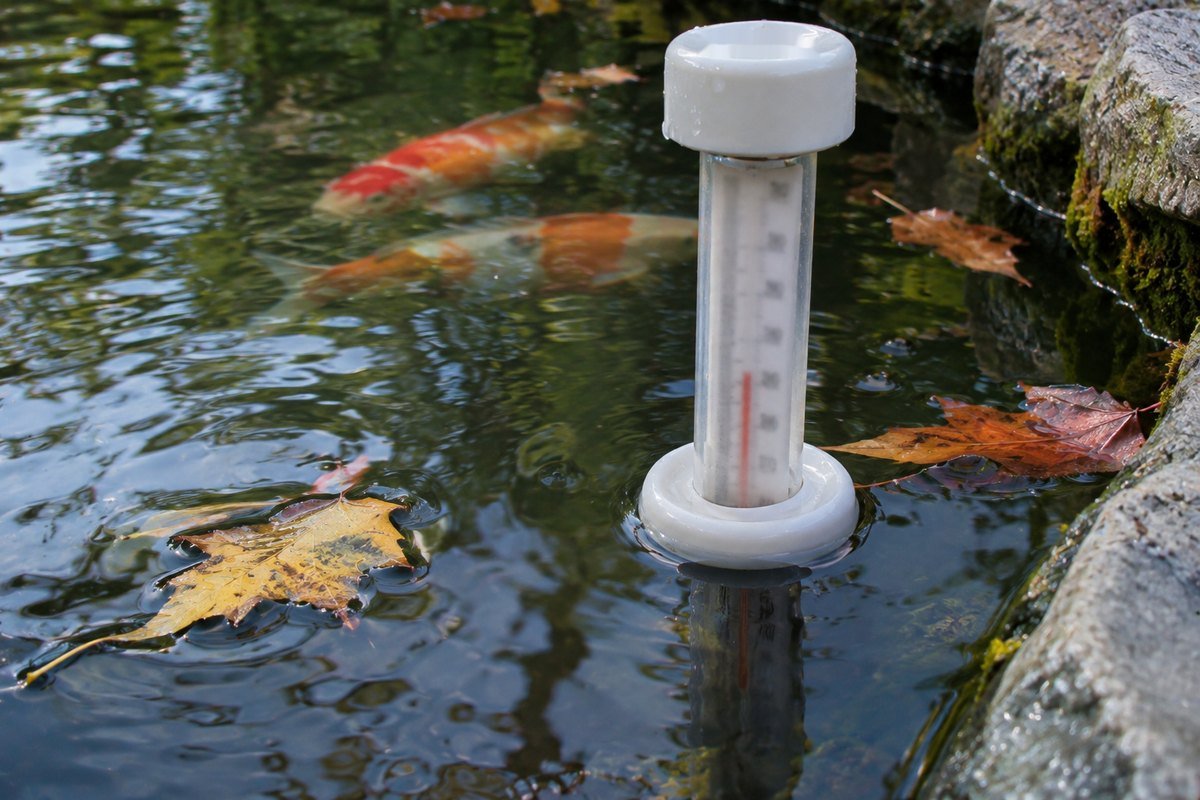
Water temperature decides almost everything about feeding koi. Measure it with a pond thermometer a foot or so below the surface, not the air temperature, and check it at the same time each day.
| Water temperature | What to feed | How often |
|---|---|---|
| Above 85°F | An easy-to-digest staple, in small amounts | Once or twice a day at most. Add aeration. |
| 68°F to 85°F | Staple, plus color or growth food if you want | 2 to 4 small meals a day |
| 60°F to 68°F | Staple or all-season food | 1 or 2 times a day |
| 50°F to 60°F | Wheat germ or cold water food | Once a day in the warmest part of the day, or every other day |
| Below 50°F | Nothing | Stop feeding until spring |
Built from feeding guides by Hikari, Kaytee, Tropical Fish Hobbyist, and Kansas State University. Where they disagree, we use the safer number.
Why we say stop at 50°F
The sources do not agree on where to stop. Hikari’s koi feeding guide says you may feed small amounts two or three times a week between 41°F and 50°F and stop below 41°F. Kaytee’s label says to feed every other day below 50°F and not at all below 40°F. Kansas State University, Tropical Fish Hobbyist, and Purdue University point to about 50°F as the line to stop or cut back sharply. Tropical Fish Hobbyist explains why: below about 50°F to 55°F, the fish cannot use the food, and it can rot in the gut.
Skipping food in cold water does no harm to a healthy koi, while feeding too much in cold water can. That is why this guide uses 50°F as the stop point. If your pond hovers in the 40s, a pinch of wheat germ food on a sunny afternoon will not hurt active fish, but it is never required.
Feeding through the hottest weeks
Very warm water is a problem too. Warm water holds less oxygen, and digestion uses oxygen. Hikari suggests no more than two feedings a day above 86°F, and Tropical Fish Hobbyist says to cut back greatly above 85°F. On hot days, feed early in the day, run an air pump or fountain at night, and see our pond aeration guide if fish gasp at the surface.
How Much to Feed Koi
Most guides stop at “feed what they eat in five minutes.” That is a good check, but it does not tell you how much food that is, and hungry koi will keep eating well past what the pond can handle. A better way is to feed a small share of the fish’s body weight each day, then use the five-minute check to fine-tune it.
Step 1: Estimate how much your koi weigh
You do not need to catch and weigh your fish. Kodama Koi Farm, a large koi breeder, gives a simple formula: a koi’s weight in pounds is about its length in inches, cubed, divided by 1,540. Measure length from the nose to the end of the tail. Thin or very full-bodied fish will vary, but this gets you close.
| Koi length | Approximate weight |
|---|---|
| 8 inches | about 0.3 lb (150 g) |
| 12 inches | about 1.1 lb (510 g) |
| 16 inches | about 2.7 lb (1.2 kg) |
| 20 inches | about 5.2 lb (2.4 kg) |
| 24 inches | about 9 lb (4.1 kg) |
Calculated with the Kodama Koi Farm formula: length in inches cubed, divided by 1,540.
Step 2: Pick a daily amount
Commercial fish farms that push carp to grow fast feed a lot. A feeding table published by the UN Food and Agriculture Organization lists 3% to 4% of body weight per day for carp weighing about 300 g to 1 kg in water at 68°F to 79°F. Farm ponds are built for that. A backyard pond with a normal filter is not, so we suggest starting much lower:
| Water temperature | Starting amount per day | With a large, well-kept filter |
|---|---|---|
| Above 85°F | About 0.5% of body weight | About 0.5% |
| 68°F to 85°F | About 1% | Up to about 2% |
| 60°F to 68°F | About 0.5% | Up to about 1% |
| 50°F to 60°F | About 0.25% | About 0.5% |
| Below 50°F | None | None |
These are PondBrief starting points, set well below fish farm rates. Adjust them with the five-minute check and your water tests.
Step 3: Split it into meals
Divide the daily amount by the number of meals in the chart above. In warm water, Hikari notes that feeding smaller amounts more often can add weight and girth faster than one big meal, and small meals are easier on the filter.
A worked example
Say you have six koi that average 14 inches long and the water is 72°F.
- Each fish weighs about 14 × 14 × 14 = 2,744, divided by 1,540, or about 1.8 lb.
- Six fish weigh about 10.7 lb, or 4.8 kg (4,850 g).
- At 1% a day, that is about 48 g of food a day.
- Split into three meals, each meal is about 16 g.
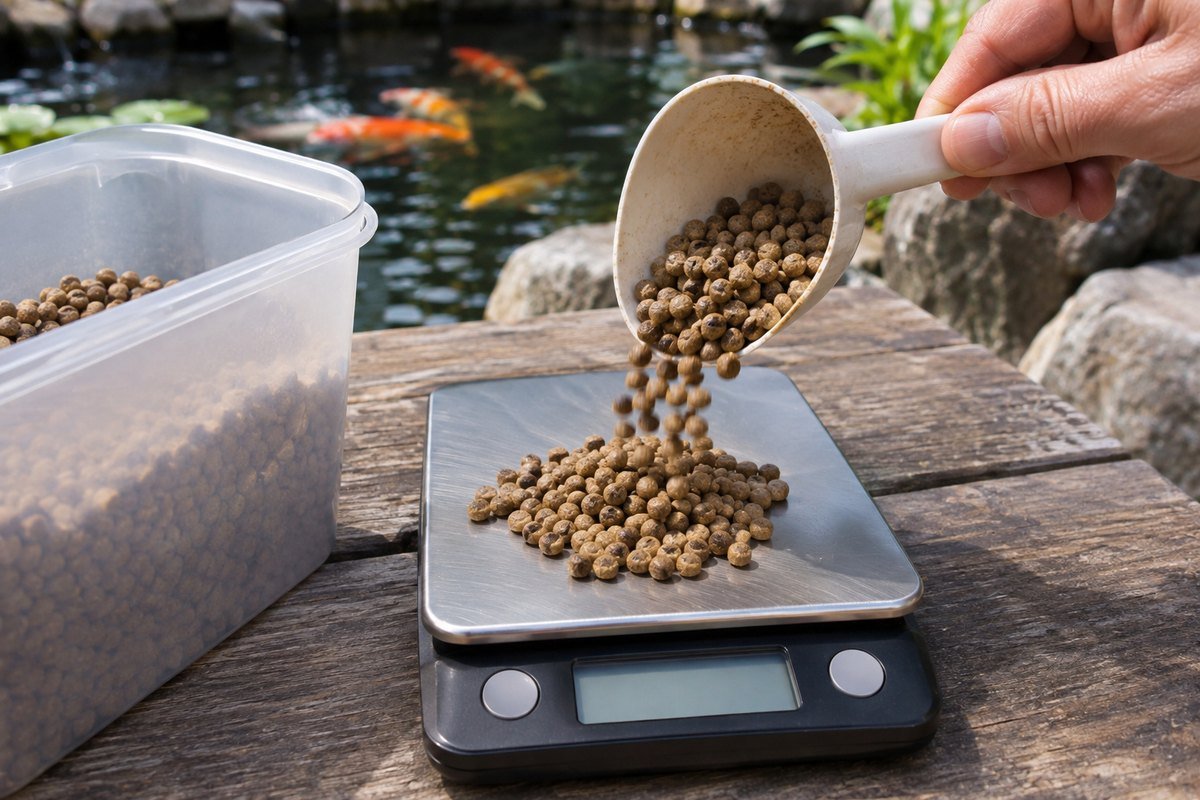
That is less food than most people expect. Weigh one scoop of your pellets on a kitchen scale once, so you know how many grams a scoop holds. After that, you can feed by the scoop.
The five-minute check
Dr. Sanders calls it the five-minute method. Sprinkle a small amount, add more as the fish clear it, and stop after about five minutes. Hikari says to remove any food left after a feeding, and Kaytee’s label says never to give more than the fish finish in 5 to 10 minutes. Use this as a ceiling, not a target. If the calculated amount is gone in one minute, that is fine. Koi always act hungry.
Koi Feeding Calculator
Enter your fish and your water temperature. The calculator estimates their weight, then suggests what to feed, how often, and how many grams a day. Not sure of your gallons or how many fish your pond can hold? Our pond calculator and pond fish guide can help.
Koi Feeding Calculator
Fill in your fish and press Work out feeding.
Koi feeding calculator by PondBrief. Weight from the Kodama Koi Farm length formula. Amounts are starting points only. Always use the five-minute check and test your water.
Pellet Size and Mixed Koi and Goldfish Ponds
Pellets that are too big get spit out and rot. Pellets that are too small make large koi work hard for little food. Food makers sell the same food in mini, small, medium, and large sizes, but sizes vary from brand to brand. As a rough guide, one koi dealer, ChampKoi, matches pellet size to fish length like this:
| Fish length | Pellet size |
|---|---|
| Under 4 inches | About 1.7 to 2.8 mm (often sold as mini or baby) |
| 4 to 8 inches | About 3.5 to 4 mm (small) |
| 8 to 14 inches | About 4.8 to 5.5 mm (medium) |
| 14 inches and up | About 7.5 to 9 mm (large) |
In a pond with fish of many sizes, buy for the smaller fish. Big koi happily eat small pellets, but small fish cannot eat large ones.
Can goldfish eat koi food? Yes. Goldfish and koi are close relatives with the same basic needs, and many foods are sold for both. Kaytee labels its Koi’s Choice for koi, goldfish, and pond fish, and TetraPond sells its Spring and Fall Diet for all pond fish. Just pick a pellet small enough for the goldfish, and scatter food across the surface so the fast koi do not get all of it. Count the goldfish in your daily amount too. A comet or shubunkin eats far less than a big koi, so they add only a little.
5 Koi Foods Worth a Look
Every pick here is sold on Amazon, and we checked each listing on 12 Nov 2026. Protein and fat are the makers’ published minimums. Any of these, fed by the temperature chart, will serve a backyard koi pond well. The brand matters far less than how you feed it.
Best staple for most ponds
Hikari Staple Floating Koi Pellets
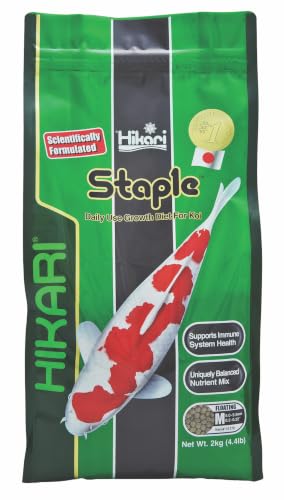
Hikari Staple is a plain everyday food from one of the best known koi food makers. Hikari recommends it as a daily diet for koi and pond fish and says it contains stabilized vitamin C. It floats and is made not to cloud the water.
Hikari’s own feeding note for this food says to feed it 2 to 4 times a day from 64°F to 86°F and switch to its Wheat-Germ food below 52°F. The pellets come in mini, medium, and large, so match the size to your fish.
- Protein: 34% minimum
- Fat: 3% minimum
- Type: Floating pellet
- Sizes: Mini, medium, large (this listing is medium, 4.4 lb)
Best for spring and fall
Hikari Wheat-Germ Floating Koi Pellets

This is Hikari’s easy-to-digest food for cooler water and for koi whose metabolism is slowing. It uses the inner part of the wheat germ kernel and has added vitamins and minerals.
Hikari says to feed it no more than twice a day between 41°F and 64°F and to stop below 41°F. We suggest stopping at 50°F, as explained in the chart above. A sinking version is also sold for shy fish.
- Protein: 32% minimum (floating)
- Fat: 4% minimum
- Type: Floating pellet, sinking also sold
- Sizes: Mini, medium, large (this listing is medium, 4.4 lb)
One bag for most of the year
Saki-Hikari Multi-Season Koi Food

Saki-Hikari is Hikari’s premium line. The Multi-Season food is made for cooler and changing water temperatures and includes probiotics and color enhancers, according to the maker. It is a good pick if your pond swings between cool and warm water in spring and fall.
Hikari designs it for water that stays above 54°F, with careful, reduced feeding between 41°F and 54°F. It is a premium food, so it costs more than a staple. For pet koi in a backyard pond, a staple plus a wheat germ food does the same job.
- Protein: 37% minimum
- Fat: 5% minimum
- Type: Floating pellet
- Sizes: Small, medium, large (this listing is medium, 4.4 lb)
Easy cool water food from a big brand
TetraPond Spring and Fall Diet Floating Sticks

TetraPond’s Spring and Fall Diet is a wheat germ based stick for all pond fish, including koi and goldfish. Tetra says it is made to be easy to digest at low temperatures, which puts less load on the fish and the filter.
It comes as floating sticks rather than pellets, and Tetra sells it for koi and goldfish alike, so it suits a mixed pond. Like any cool water food, feed it in small amounts and stop when the water stays below 50°F.
- Protein: 32% minimum
- Fat: 6% minimum
- Type: Floating stick
- Size: 1.72 lb bag
Good value for big ponds
Kaytee Koi’s Choice Floating Fish Food
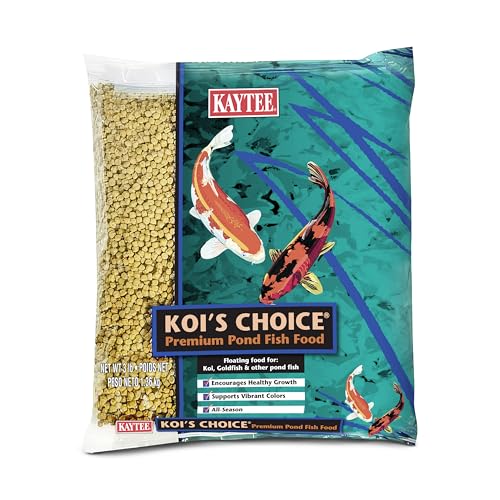
Kaytee’s Koi’s Choice is a floating food for koi, goldfish, and other pond fish, sold in large bags. Its guaranteed analysis is in the same range as the Hikari staples.
Kaytee’s label gives its own temperature guide: one to five feedings a day above 60°F, one or two from 50°F to 60°F, every other day below 50°F, and none below 40°F. We suggest stopping at 50°F instead. Buy a bag size you can use up in a few months so the vitamins stay fresh.
- Protein: 35% minimum
- Fat: 5% minimum
- Type: Floating pellet
- Note: Sold in several bag sizes
Treats Koi Can Eat and Foods to Avoid
Treats are fun and help tame koi, but they are not a full diet. Keep them to a small part of what you feed, and only offer them in warm water.
| Good treats in warm water | Skip these |
|---|---|
| Watermelon and orange slices | Bread, crackers, and cereal |
| Lettuce such as romaine | Dog and cat food |
| Shrimp and krill | Salty, oily, or seasoned table food, and anything moldy |
Dr. Sanders lists watermelon, oranges, and lettuce as healthy treats, and suggests trying those before dried krill. She also warns against high-carbohydrate foods such as cereal and rice when the water is cool. Bread and crackers are mostly starch with little of what koi need, and pet foods are made for mammals, not fish. Remove any treat the fish ignore within a few minutes.
Feeding Koi Through the Seasons
Spring: start slowly
Spring is the riskiest time to feed. The fish are hungry after winter, but their bodies and your filter bacteria are still waking up. Hikari advises restarting with an easy-to-digest food such as wheat germ and raising the amount little by little. Wait until the water has stayed above 50°F for several days in a row, not just one warm afternoon. Start with one small meal a day and test for ammonia as you increase.
Summer: feed more, watch the oxygen
Between about 68°F and 85°F, koi are most active and can take two to four small meals a day. This is the time for growth or color foods if you use them. Hikari advises against feeding within an hour of sunrise or sunset. Tropical Fish Hobbyist suggests skipping one day a week to keep digestion regular.
Fall: wind down
As the water drops below about 60°F, switch to a wheat germ food and feed less often. Clean leaves out of the pond, since rotting leaves use oxygen over the winter. Our seasonal pond care guide has a full fall checklist.
Winter: let them rest
Below 50°F, stop feeding. Koi rest near the bottom and live off their body reserves until spring. Keep a hole open in the ice so gases can escape. Our pond heater and de-icer guide explains how. If you run a true heater that keeps the water above 60°F, follow the chart for the actual water temperature.
What Overfeeding Does to Your Pond
Food the fish do not use becomes waste. Uneaten food rots, and fish waste breaks down into ammonia. A University of Florida extension guide on fish health lists overfeeding, along with crowding, as a cause of toxic ammonia and nitrite in water with a working filter. Your filter bacteria turn ammonia into nitrite and then into nitrate, and nitrate feeds algae. More food leads to more waste, more nitrate, and greener water.
Signs you are feeding too much:
- Food is still floating after five minutes.
- The water turns cloudy or green soon after you raise the amount. See our green pond water guide.
- Your test kit shows any ammonia or nitrite. Both should read zero. See our pond water test kit guide.
- Foam that lingers on the surface, or sludge building up on the bottom.
- The filter clogs much faster than it used to. Our pond filter guide covers sizing.
The fix is simple. Cut the amount in half, net out leftovers, and test the water again in a few days. Do not add a chemical treatment until you have cut back on feeding.
Feeding Koi in a New Pond or After Adding Fish
A new filter needs time to grow the bacteria that handle fish waste. Hikari advises feeding less until the filter has fully cycled. Test for ammonia and nitrite every few days for the first several weeks, and cut feeding whenever either one shows up.
New fish are often too stressed to eat for the first few days, and that is normal. Our pond fish guide explains how to quarantine new koi before they join the pond. Offer a little food after a day or two, and remove what they don’t eat.
Feeding Koi While You Are on Vacation
Healthy koi in an established pond can skip a week of meals. Aquascape, a large pond equipment maker, says they generally don’t need food if you are away for one week, and that skipping meals is usually safer than having someone overfeed. Before you leave:
- Feed normally in the days before the trip. Do not add extra.
- Clean the skimmer and filter, and check that the pump and aeration are running.
- For longer trips, measure out each meal in a bag or pill box so a neighbor cannot overfeed.
- If you use an automatic feeder, run it for a week while you are still home to check the amount it drops.
Koi Not Eating? Common Causes
| What you see | Likely cause | What to do |
|---|---|---|
| The whole pond ignores food in fall or spring | Cold water | Check the thermometer. Below 50°F, this is normal. |
| Fish ignore food on a hot afternoon | Warm water with low oxygen | Feed early in the day and add aeration. |
| New fish hide and do not eat | Stress from the move | Give them a few days. Offer small amounts. |
| All fish stop eating and act sluggish | Poor water quality | Test ammonia, nitrite, and pH. Do a partial water change if needed. |
| Fish gasp at the surface | Low oxygen | Add aeration right away and stop feeding until it improves. |
| One fish hides, has clamped fins, sores, or red streaks | Possible illness or parasites | Test the water, and call a vet who treats fish. |
A whole pond that stops eating usually points to the water. One fish that stops while the rest eat usually points to that fish. A vet who treats fish can examine a sick koi and test the water.
How to Store Koi Food
Fish food loses its vitamins over time. Dr. Sanders explains that food starts losing vitamin C as soon as you open it, and that within a few months there is barely any left. Flakes lose it faster than pellets.
- Buy a bag size you will use up in a few months, even if a bigger bag is cheaper per pound.
- Keep it in an airtight container in a cool, dark, dry place, such as a pantry.
- Avoid a hot shed or a garage that heats up in summer.
- Throw out food that smells sour, looks moldy, or has gone soft.
- Start each season with a fresh bag rather than last year’s leftovers.
Common Koi Feeding Mistakes
- Feeding by the calendar instead of the thermometer. A warm week in March does not mean the pond is warm.
- Feeding every time the fish beg. Koi always act hungry.
- Using growth food all the time. High-protein food adds waste. Save it for warm water and strong filters.
- Feeding color food as the only food. Mix it with a staple.
- Pellets that are too big for the smallest fish. Buy for the small fish in a mixed pond.
- Leaving uneaten food in the pond. Net it out after each meal.
- Feeding a full meal on the first warm day of spring. Start slowly with an easy-to-digest food.
- Buying a huge bag that sits open for a year. The vitamins fade.
Koi Food Questions
What is the best koi food?
For most backyard ponds, a floating staple pellet with about 32% to 36% protein, in a size that fits your smallest fish, plus a wheat germ food for spring and fall. Hikari Staple and Hikari Wheat-Germ are a common pair. How you feed matters more than the brand.
How often should I feed koi?
It depends on water temperature. Feed 2 to 4 small meals a day between 68°F and 85°F, once or twice a day from 60°F to 68°F, once a day or every other day from 50°F to 60°F, and not at all below 50°F.
How much should I feed my koi?
Start with about 1% of the fish’s body weight per day in warm water and less in cool water. A 14-inch koi weighs about 1.8 lb, so six of them need about 48 g of food a day at 72°F. Never give more than they can finish in about five minutes.
When should I stop feeding koi in the fall?
Stop when the water stays below about 50°F. Switch to a wheat germ food and feed less once the water drops below about 60°F.
Can goldfish eat koi food?
Yes. Koi and goldfish have similar needs, and many foods are sold for both. Choose a pellet small enough for the goldfish to eat.
Can koi eat bread?
It is best not to feed it. Bread is mostly starch with little of what koi need, and a fish veterinarian warns against high-carbohydrate foods such as cereal and rice in cool water. Watermelon, oranges, or lettuce make better treats.
How long can koi go without food?
Healthy koi in an established pond can go a week without food in warm weather, according to Aquascape. In winter, they eat nothing for months while the water stays cold.
Do koi eat algae?
They graze on some algae, along with insects, larvae, and plants. But koi will not clear a green pond, and their waste can feed more algae. See our green pond water guide for real fixes.
Do I need a special winter koi food?
Below 50°F, you do not need any food. For cool water between about 50°F and 60°F, wheat germ or cold-water food is easy to digest. Feeding less matters more than the type of food.
Where to Go Next
Planning your fish? Start with our pond fish guide for how many koi your pond can hold. Keep the water healthy with our guides to pond filters, pond aeration, and pond water test kits. Getting ready for winter? Read our pond heater and de-icer guide.