
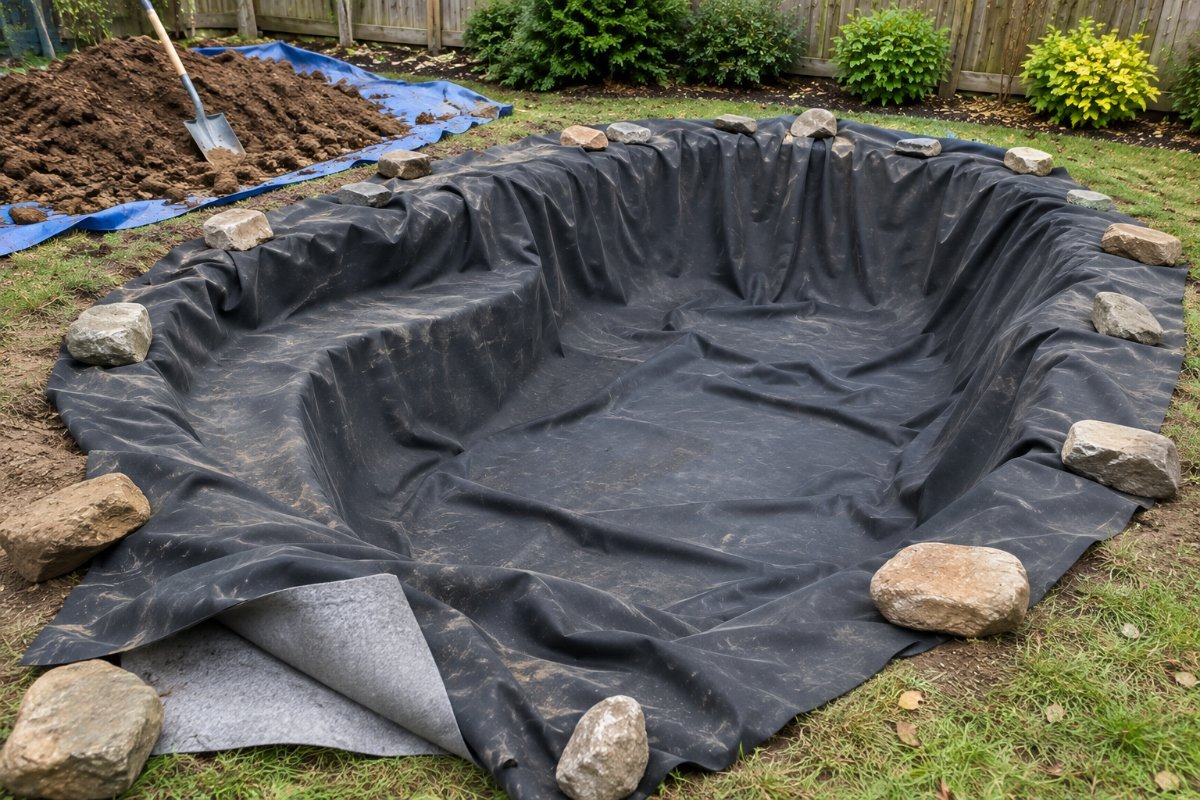
A pond liner is the waterproof layer that holds the water in a backyard pond. For most home ponds, the best choice is a 45 mil EPDM rubber pond liner laid over a protective underlayment. To size one, take the pond’s length and width, add twice its maximum depth to each, and then add 2 more feet to each for overlap at the edges.
That is the short answer. The rest of this guide explains each part. It covers the main types of pond liner, what the thickness numbers mean, and how to measure for the right size. It also shows how to install a liner so it lasts for decades.
Table of Contents
The short answer
- Best for most ponds: 45 mil EPDM rubber. It is flexible, fish-safe when sold for ponds, and folds neatly into corners and shelves.
- Best for large or rocky sites: RPE (reinforced polyethylene). It is lighter than EPDM and resists punctures better, but it is stiffer to fold.
- Cheapest: PVC (vinyl) or thin HDPE (a stiff plastic). Both cost less up front. PVC breaks down sooner in sunlight, and thin HDPE is stiff and hard to fold.
- Easiest for a small pond: a preformed (rigid) pond shell, if one of the stock shapes suits your space.
- Liner size: pond length plus twice the maximum depth plus 2 feet, by pond width plus twice the maximum depth plus 2 feet.
- Always add an underlayment beneath the liner to protect it from stones and roots.
The main types of pond liner
Pond liners come in two broad groups. Flexible liners are large sheets that you lay into a hole of any shape. Preformed liners, also called pond shells, are rigid tubs molded into a fixed shape. Within the flexible group, four materials are common.
EPDM rubber
EPDM stands for ethylene propylene diene monomer. It is a synthetic rubber and the most widely used flexible pond liner in the United States. POND Trade Magazine estimates that nearly all pond kits sold in the U.S. include an EPDM liner.
EPDM stretches and folds easily, so it fits curved edges, steps, and planting shelves (shallow ledges inside the pond edge) without much effort. You can patch it if it gets a hole. Its weak points are its weight and how easily a sharp object can puncture it. A 10 by 10 foot sheet of 45 mil PondGard EPDM weighs about 29 pounds, and a sharp stone underneath can pierce it. That is why EPDM should always sit on an underlayment.
RPE (reinforced polyethylene)
RPE is a thin polyethylene sheet with a woven fabric layer inside it for strength. It is common on larger ponds and lakes. According to POND Trade Magazine, RPE can withstand more than twice the bursting pressure of EPDM and weighs about half as much per square foot. Pond supplier Play It Koi reports RPE warranties of up to 40 years even when the liner is left exposed to the sun.
The downsides are stiffness and seaming. RPE does not fold into tight corners as neatly as EPDM, and joining two pieces requires heat-welding equipment rather than tape or glue.
PVC
PVC (polyvinyl chloride) liners are light, inexpensive, and easy to fold. They are a reasonable choice for small, temporary, or patio water features. The drawback is lifespan. Sunlight makes PVC brittle over time, and Natural Waterscapes puts its life at about 10 to 15 years, compared with 20 to 30 years for EPDM. If you use PVC, keep it fully covered with rocks, gravel, or soil wherever it faces the sun.
HDPE
HDPE (high density polyethylene) is a stiff plastic sheet. Thin HDPE liners are among the cheapest options sold online. Thick HDPE is durable but rigid, so it suits large commercial ponds installed with welded seams. For a typical backyard pond, it is harder to shape than EPDM or RPE.
Preformed (rigid) pond shells
A preformed pond is a molded plastic or fiberglass tub with the depth and shelves already built in. It is quick to install and needs no folding. The limits are size and shape, because you can only choose from stock designs. The Royal Horticultural Society (RHS) notes that fiberglass shells are very durable. Plastic edges, however, can become brittle and crack with age, and a cracked plastic shell usually cannot be repaired.

| Material | Typical thickness | Flexibility | Puncture resistance | Expected life | Best for |
|---|---|---|---|---|---|
| EPDM rubber | 45 mil | Very flexible | Fair, needs underlayment | 20 to 30 years | Most backyard ponds, waterfalls, and streams |
| RPE | 20 to 30 mil | Stiffer | Excellent | 20 years or more, warranties up to 40 | Large ponds and ground with many rocks or roots |
| PVC | 20 to 30 mil | Very flexible | Fair | 10 to 15 years | Small or short-term water features on a budget |
| HDPE | Varies | Rigid | Good | 20 years or more | Large, professionally installed ponds |
| Preformed shell | Not applicable | Fixed shape | Good | Longer for fiberglass, shorter for plastic | Small ponds where a stock shape fits |
For a closer look at the three most common flexible liners, see our EPDM pond liner vs HDPE vs PVC comparison.
When you are ready to buy, see our picks for the best pond liner for a small backyard pond.
What thickness pond liner do you need?
Liner thickness is measured in mil. One mil is one thousandth of an inch, so it is not the same as a millimeter. A 45 mil liner is about 1.14 millimeters thick.
For EPDM, 45 mil is the standard for backyard ponds. PondGard, Aquascape, and most pond kits use this thickness, and a pond expert quoted by the U.S. pet retailer Chewy also recommends a fish-safe 45 mil EPDM liner for small residential ponds. EPDM is also sold as a roofing material. Do not use roofing EPDM in a pond (more on that below).
RPE is thinner for the same strength because of its fabric layer. Natural Waterscapes, a pond supplier, says a 30 mil RPE liner resists punctures better than 45 mil EPDM. PVC liners are usually 20 to 30 mil. If you choose PVC, pick the thicker end of that range.
How to work out pond liner size
Measure the hole at its longest point and its widest point. Then measure its maximum depth, which is the depth at its deepest point. Then use this formula. It is the standard method given by pond suppliers such as That Pet Place and by the home services site Angi:
- Liner length = pond length + (2 × maximum depth) + 2 feet
- Liner width = pond width + (2 × maximum depth) + 2 feet

We double the depth because the liner has to run down one side of the hole and back up the other. The extra 2 feet gives you 1 foot of overlap on every edge, which you will hide under stones later.
Worked example. Say your pond is 10 feet long, 7 feet wide, and 2 feet deep at its deepest point:
- Length: 10 + (2 × 2) + 2 = 16 feet
- Width: 7 + (2 × 2) + 2 = 13 feet
You need a pond liner at least 16 by 13 feet. Liners are usually sold in set sizes. Aquascape, for example, sells liners in 5-foot increments, so you would buy the next size up: a 20 by 15-foot liner. A little extra is fine. A liner that is even a few inches short is a serious problem, because you cannot stretch it and joining pieces is difficult.
If your pond has an irregular shape, measure the longest and widest points, not the average. Planting shelves do not change the formula. Whether the sides drop straight down or step down in shelves, the liner covers the same total width and the same total depth. To skip the math, use the pond calculator on our homepage, which uses this same rule.
Flexible liner or preformed pond?
Choose a preformed shell if your pond will be small, you like one of the stock shapes, and you want the simplest install. The hole must match the shell closely and be level, or the shell can flex and crack under the weight of the water.
Choose a flexible pond liner for anything larger, for a natural curved shape, or if you want a waterfall or stream. Flexible liners let you set your own depth and shelf layout, and you can patch a hole in EPDM or PVC. Most of this guide assumes a flexible liner, because that is what most backyard ponds use.
Do you need underlayment?
Yes. Underlayment is a protective layer that goes between the soil and the liner. It cushions the liner against stones, roots, and sharp debris that could pierce it from below.
The usual choice is geotextile underlayment, a thick non-woven fabric made for this job. The British aquatics retailer World of Water notes that sand helps level the hole but gives little protection from stones and none from roots. The RHS suggests adding a 1-inch layer of damp sand under the fabric in stony ground. When you need more than one piece of underlayment, overlap the pieces by at least 3 inches, as Chewy advises.
Underlayment costs far less than replacing a punctured liner.
How to install a pond liner, step by step
- Mark and dig the hole. Outline the shape with a garden hose or rope. Dig to your planned depth, leaving a shelf about 1 foot wide and 1 foot below the edge for marginal plants, which are plants that grow in shallow water at the pond’s edge. The RHS recommends sides that slope outward slightly, by about 20 degrees, rather than dropping straight down. This helps the pond cope with ice pressure in winter.
- Clear the hole. Remove stones, roots, and anything sharp. Level the top edge all the way around. If one side is lower, water will spill over there first, and the liner will show on the higher side.
- Lay the underlayment. Cover the bottom and sides, overlapping any seams by at least 3 inches.
- Unfold the liner on a warm day. EPDM becomes stiff in the cold. Natural Waterscapes suggests installing on a day above 60°F so the rubber is easier to shape. Let the liner warm in the sun for a while before you start.
- Drape the liner loosely. Center it over the hole and let it sag into the bottom. Do not pull it tight. Weigh down the edges with a few smooth stones.
- Fold, do not cut. Make neat, large folds at curves and corners rather than many small wrinkles. Never cut the liner to remove a fold.
- Fill slowly. Run a hose into the pond. As it fills, smooth the liner into place and adjust the folds. The water’s weight presses the liner into the shape of the hole.
- Let it settle. Chewy suggests waiting at least 24 hours after filling before trimming so the liner can fully settle.
- Trim and cover the edge. Trim the extra liner, leaving about 6 to 18 inches beyond the edge. Cover this with flat stones, gravel, or soil so no part of the liner is left in the sun.

For the whole project, from choosing the spot to the first fill, see our step-by-step guide on how to build a pond.

Fish-safe EPDM versus roofing rubber
EPDM is also sold for flat roofs, and roofing rubber often costs less. Do not use it in a pond. Roofing membranes are made for roofs, not for water that holds fish and plants, and pond suppliers such as That Pet Place warn that they are not fish-safe. Buy a liner sold specifically as a pond liner and labeled fish-safe. PondGard, for example, is formulated to be safe for fish and plant life and carries a 20-year limited warranty.
How long does a pond liner last?
A good pond liner can last for decades. Typical ranges reported by suppliers and the RHS are:
- EPDM: 20 to 30 years, often backed by a 20-year warranty.
- RPE: 20 years or more, with some warranties of up to 40 years.
- PVC: about 10 to 15 years.
- Butyl rubber (common in the UK): 25 to 50 years or more, according to the RHS.
Sunlight is one of the main things that shorten a liner’s life. The more of the liner you cover with rock, gravel, or soil, the longer it will last. Roots, sharp stones, and animals with claws are the other common causes of damage.
What to do if your pond is losing water
Some water loss is normal. On hot, windy days, a pond can lose a noticeable amount of water to evaporation. A leak is more likely if the level drops quickly, or if it always stops dropping at the same height.
Start by checking the edges. A common cause is a liner edge that has slipped below the water line, especially around a waterfall or stream. If the edges look fine, let the water level drop until it stops. The leak is usually at or just below the height where the water stops. You can fix small holes in EPDM and PVC with a patch kit for that liner type. Clean and dry the area first, as the kit directs.

Mistakes to avoid
- Buying the exact size. Always round up. A short liner won’t stretch.
- Skipping the underlayment. A single sharp stone can puncture the liner.
- Trimming too early. Fill the pond and let it settle before you cut anything.
- Using roofing rubber. Use only liners labeled fish-safe for ponds.
- Leaving the liner exposed. Cover the edges to protect them from sunlight.
- Cutting out folds. Large, neat folds are normal and do not leak.
Pond liner FAQ
What is the best pond liner for a backyard pond?
For most backyard ponds, a 45 mil EPDM rubber pond liner is the best overall choice. It is flexible, fish-safe when sold for ponds, and lasts about 20 to 30 years. RPE is a strong alternative for large ponds or rocky ground.
How thick should a pond liner be?
For EPDM, choose 45 mil (about 1.14 millimeters). RPE liners are usually 20 to 30 mil because their fabric layer adds strength. PVC liners are usually 20 to 30 mil.
What size pond liner do I need for a 10-by-10-foot pond?
It depends on depth. For a pond 2 feet deep at its deepest point, add 4 feet for depth and 2 feet for overlap to both the length and the width. That gives 16 by 16 feet, so you would buy the next stocked size up, often 20 by 20 feet.
Do I need underlayment under a pond liner?
Yes. Underlayment protects the liner from stones and roots. Geotextile fabric is the usual choice, and sand alone does not stop roots, according to World of Water.
Can a pond liner be repaired?
Yes, in most cases. You can fix small holes in EPDM and PVC liners with a patch kit made for that material. Cracked plastic preformed shells usually cannot be repaired, but fiberglass shells can be patched.
Bottom line
For most people building a backyard pond, the answer is simple. Buy a 45 mil EPDM pond liner labeled fish-safe. Size it with the formula above and round up. Lay it over geotextile underlayment, fill the pond before you trim, and cover the edges from the sun. If you follow these steps, a pond liner should hold water for 20 years or more.