

If your pond has fish, it is worth adding an air pump. Fish need oxygen in the water, and a pond can run short on hot summer nights, after cloudy days and under winter ice. A small aeration kit pushes air through a stone or disc at the bottom of the pond, and the rising bubbles keep the water moving and mixing with air. It is cheap to run, too. A 6 watt kit costs about $9.50 a year in electricity.
The finder below matches your pond’s size and depth to kits from Aquascape, EasyPro and OASE, using each maker’s own ratings.
Pond aerator finder
Enter your pond size and depth. The finder checks each kit against its maker’s own pond size and depth ratings and shows the ones that fit, cheapest to run first.
Makers note that fish load affects how big a pond a kit can really handle. If your pond is crowded with large fish, choose a kit rated for a bigger pond than yours. Don’t know your gallons? Our pond calculator works it out from length, width and depth.
| Aeration kit | Rated for ponds up to | Air output | Diffusers | Watts | Cost to run a year |
|---|
Pond size and depth ratings, air output and watts come from each maker’s product page. OASE rates its kits in cubic meters, shown here in gallons, and lists no depth rating, so the finder only shows OASE kits for ponds up to 5 feet deep. The two EasyPro KLC kits are also rated for a minimum pond size. Running cost assumes the air pump runs all day, every day.
Pond aerator finder by PondBrief · pondbrief.com
Why Pond Oxygen Runs Low
Warm water holds less oxygen than cold water. That is the main reason oxygen trouble shows up in summer. Here is the most oxygen fresh water can hold at each temperature at sea level, in milligrams per liter (mg/L), from the EPA’s water monitoring tables:
| Water temperature | Most oxygen it can hold |
|---|---|
| 50°F | 11.3 mg/L |
| 60°F | 9.9 mg/L |
| 70°F | 8.9 mg/L |
| 80°F | 8.0 mg/L |
| 90°F | 7.3 mg/L |
Fish do best with at least 5 mg/L of oxygen. Most become stressed at 2 to 4 mg/L, and fish start to die below about 2. At 90°F, even a pond that is completely full of oxygen holds only 7.3 mg/L, so there is not much extra.
Oxygen also rises and falls during the day. Algae and plants add oxygen in sunlight, but at night they use it up, along with the fish. Oxygen is usually lowest just before dawn. These conditions lower it even more:
- Several cloudy days in a row. Less sun means plants and algae make less oxygen.
- An algae die-off. When a bloom dies suddenly, the rotting algae use up oxygen fast.
- Too many fish. More fish and more food mean more oxygen used.
- Ice that seals the pond. A solid sheet of ice stops fresh air from reaching the water.
Signs Your Pond Needs More Air
The clearest sign is fish gulping at the surface, especially early in the morning. If you see this, add air right away. Running a waterfall or fountain adds some oxygen while you set up an air pump.
Is a Waterfall or Fountain Enough?
Moving water does pick up oxygen, so a waterfall helps. A fountain adds a little oxygen at the surface, but spraying water is a weak way to add oxygen and does little to mix the deeper water. Our pond fountain guide covers how to choose and size one.
An air pump works from the bottom up. Bubbles rising from a diffuser on the pond floor pull deeper water up to the surface, where it can take in oxygen. It also keeps running quietly at night, when you might turn a waterfall off. A good setup uses both: a waterfall for the look and sound, and a small air pump as backup.
How to Choose an Aeration Kit
Match the pond size. Makers rate each kit for a maximum number of gallons. Pick one rated for at least your pond’s volume. Makers note that fish load affects the real limit, so if your pond holds a lot of large fish, choose the next size up.
Check the depth. An air pump has to push air down against the weight of the water. Each kit lists the deepest pond it can work in. The small EasyPro CAS kits, for example, are rated to 4 feet. The Aquascape kits go to 6.5 to 11.5 feet.
Think about running cost. Air pumps are much cheaper to run than water pumps. The smaller kits in the finder use 2.7 to 15 watts, which works out to about $4 to $24 a year at 18 cents per kilowatt hour, close to the average US home rate in 2026.
Air stones or membrane diffusers. Small kits come with air stones or discs. The larger kits use rubber membrane diffusers. In summer, most kits are made to sit on the pond floor in the deepest spot. If the bottom is mucky, raise the diffuser slightly so it doesn’t stir up the sludge.
Aerating a Pond in Winter
In winter, the deepest water stays a little warmer than the rest, and that is where fish rest. A diffuser on the bottom would mix that water with the cold water above. So move it up. Aquascape suggests placing the diffuser about 1 to 1.5 feet below the surface for winter.
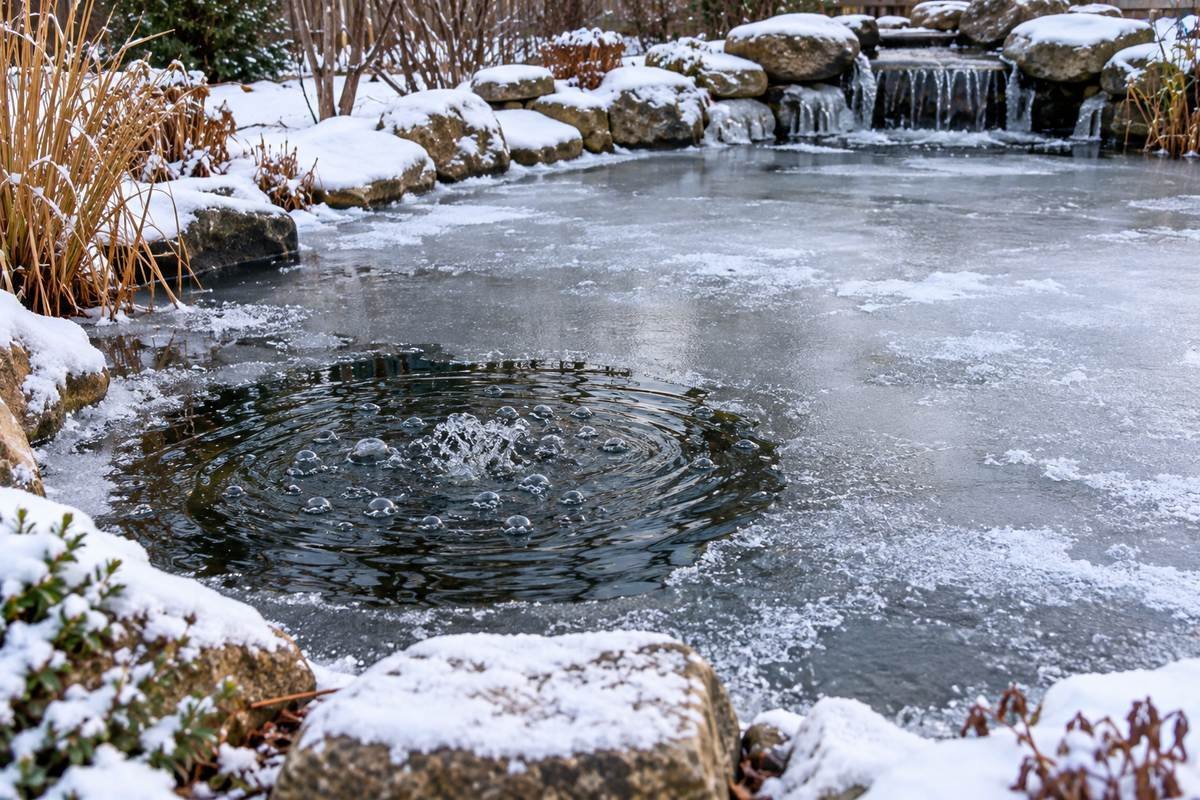
The bubbles at the surface also help keep a small hole open in the ice. That hole matters. Carbon dioxide and gases from rotting leaves build up under sealed ice, and the hole lets them escape. Never break the ice by force.
Common Questions
Does a pond without fish need an air pump?
It is less important, but it can still help. Oxygen-rich water helps leaves and other waste on the bottom break down faster.
Will an air pump stop algae?
Not on its own. Aeration helps waste break down faster and protects fish if a bloom dies off, but green water usually needs other fixes as well. Our guide to green pond water covers what works.
Do I need an air pump if I already have a water pump?
Not always, but it is a good backup for a fish pond. A water pump that feeds a waterfall adds oxygen near the surface, while an air pump mixes the whole pond and keeps working if the water pump fails. To size the water pump itself, see what size pond pump you need.