
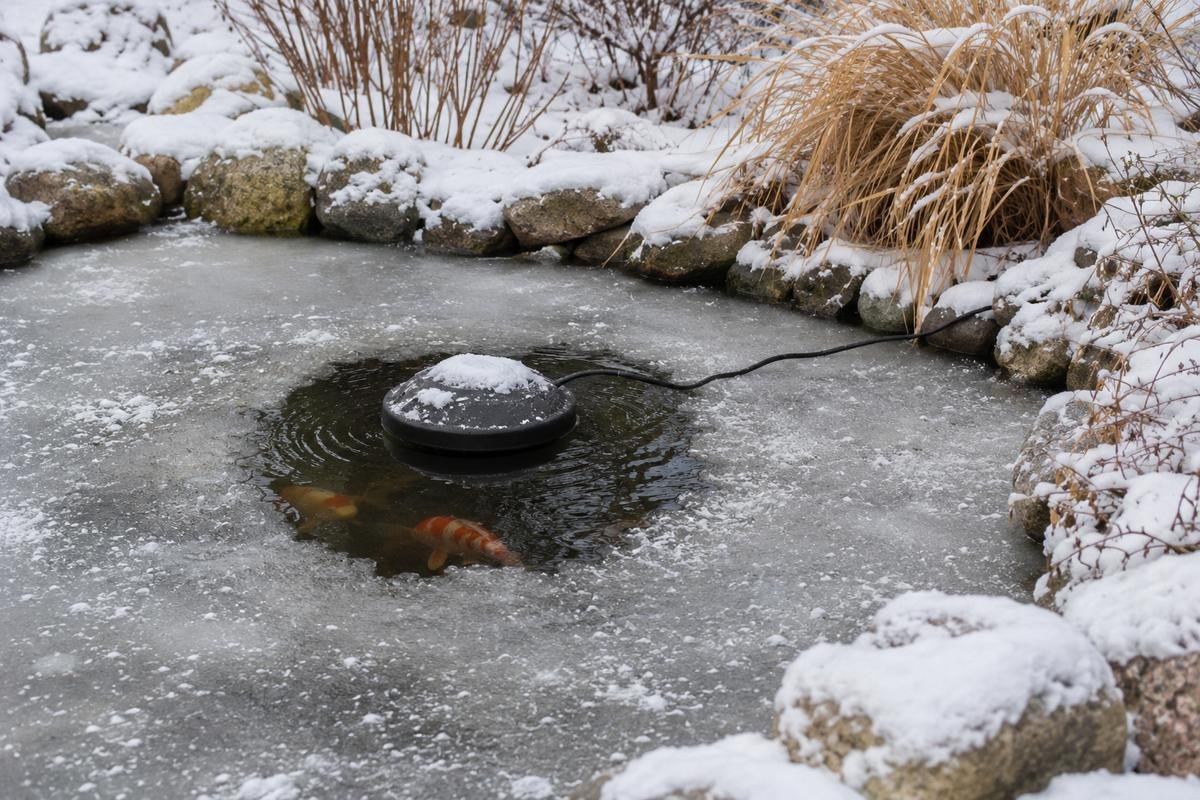
A pond de-icer keeps a small hole open in the ice so harmful gases can escape and your fish can survive the winter. A true pond heater warms the whole pond, which most backyard ponds do not need and which costs far more to run. For most goldfish and koi ponds in cold areas, a floating de-icer with a thermostat is the right choice, and the wattage depends on your pond size and how cold your winters get.
PondBrief is a participant in the Amazon Services LLC Associates Program, an affiliate advertising program designed to provide a means for sites to earn advertising fees by advertising and linking to Amazon.com. As an Amazon Associate, we earn from qualifying purchases.
This guide explains why fish ponds need an opening in the ice, how a de-icer differs from a pond heater, how to pick the wattage, and what one costs to run. It also has a sizing tool and five de-icers worth a look. We have not tested these products ourselves. Specs come from the makers, their manuals and their Amazon listings, and the winter advice comes from university extension services and pond equipment makers, named in each section.
Table of Contents
Why a Fish Pond Needs a Hole in the Ice
Leaves, fish waste, and dead plants keep breaking down on the pond floor all winter. Iowa State University Extension explains that this decay gives off carbon dioxide, methane, and hydrogen sulfide, which are toxic to fish. When ice seals the pond's surface, those gases have nowhere to go.
Oxygen is the other problem. The Minnesota Department of Natural Resources says fish die in winter when dissolved oxygen gets too low, and it lists thick ice and snow cover among the causes. That page is about lakes, but the same idea applies to a backyard pond. Purdue University adds that snow on the ice blocks light, so pond plants make less oxygen.
An open hole lets gases out and air in. Iowa State's rule of thumb is a hole about one foot across for every 100 square feet of pond surface. For most small garden ponds, that means one de-icer is enough.
Pond Heater vs De-Icer: What Is the Difference?
People often use the two names for the same thing, and many products are sold as a "pond heater" when they are de-icers. Here is the real difference.
| De-icer | Pond heater | |
|---|---|---|
| What it does | Keeps a small hole open in the ice | Raises the temperature of the pond water |
| Typical power | 100 to 1,500 watts | About 1,000 watts per 1,000 gallons, per one koi pond guide |
| Thermostat | Most turn on near freezing and off when the water warms | Set to a target water temperature |
| Running cost | Low to moderate | High |
| Best for | Most goldfish and koi ponds that freeze over | Koi keepers who want warmer water all winter |
Pond supply company The Pond Guy puts it simply: de-icers are not meant to turn up the heat, only to melt a hole in the ice. A true heater is a different tool. The pond blog Pond Informer suggests at least 1,000 watts of heater for every 1,000 gallons, and its cost example assumes the heater runs 24 hours a day. That is why most hobbyists only heat a pond to keep prized koi active or to help sick fish, and use a de-icer the rest of the time.
What Size Pond De-Icer Do You Need?
Two things set the wattage: how many gallons your pond holds and how cold your winters get. K&H Pet Products, a major maker of floating de-icers, publishes a sizing chart by USDA plant hardiness zone. Find your zone on the USDA Plant Hardiness Zone Map, then match it to your pond size.
| USDA zone | Up to 100 gal | 100 to 400 gal | 400 to 750 gal | 750 to 1,000 gal | 1,000 to 1,200 gal |
|---|---|---|---|---|---|
| Zone 3 | 250 W | 750 W | 750 W | 1,500 W | 1,500 W |
| Zone 4 | 250 W | 750 W | 1,500 W | 1,500 W | 1,500 W |
| Zone 5 | 250 W | 250 W | 750 W | 750 W | 1,500 W |
| Zone 6 | 250 W | 250 W | 250 W | 750 W | 750 W |
| Zone 7 | 250 W | 250 W | 250 W | 250 W | 750 W |
| Zone 8 | 250 W | 250 W | 250 W | 250 W | 750 W |
Source: K&H Pet Products de-icer zone chart for its Deluxe pond de-icers. W means watts.
K&H says that for ponds over 1,200 gallons, you add up several gallon columns to equal your pond size and use one de-icer for each. Not sure how many gallons you have? Our pond calculator works it out from length, width, and depth.
The chart only covers K&H's Deluxe de-icers. K&H's smaller 100-watt Thermo-Pond 3.0 is rated for ponds up to 1,000 gallons and keeps a 12-inch hole open, so it is a common pick for small ponds. The two ratings come from different K&H pages. The Thermo-Pond keeps just one 12-inch hole open, so in colder zones, or in a pond with lots of fish or leaves, the chart size is the safer pick.
Pond De-Icer Size and Cost Finder
Pick your zone, enter your pond size, and the tool suggests a de-icer wattage from the K&H chart. It also estimates the running cost based on your power rate.
Pond De-Icer Size and Cost Finder
Fill in your pond and press Find my de-icer.
De-icer finder by PondBrief. Wattage from the K&H Pet Products zone chart. Costs are estimates only.
How Much Does a Pond De-Icer Cost to Run?
The math is the same for any electric heater: watts divided by 1,000, times the hours it runs, times your price per kilowatt-hour (kWh). The U.S. Energy Information Administration put the average home electricity price at about 18 cents per kWh in mid 2026. Check your own bill for your exact rate.
| De-icer | Power per day | Cost per day | Cost per 30 days |
|---|---|---|---|
| 100 W | 2.4 kWh | about $0.43 | about $13 |
| 250 W | 6.0 kWh | about $1.08 | about $32 |
| 300 W | 7.2 kWh | about $1.30 | about $39 |
| 750 W | 18.0 kWh | about $3.24 | about $97 |
| 1,500 W | 36.0 kWh | about $6.48 | about $194 |
Running all day and all night at 18 cents per kWh. A thermostat that cycles off will lower these numbers.
Those numbers assume the de-icer runs all day and all night. A de-icer with a thermostat turns itself on and off as needed, so it usually costs less. A true pond heater sized at 1,000 watts or more costs many times more, which is why de-icers are the usual choice.
5 Pond De-Icers Worth a Look
Every pick here is sold by Amazon. We checked each listing on 5 Nov 2026. All are made for outdoor ponds and keep an opening in the ice rather than warming the whole pond.
Best for most ponds
K&H Perfect Climate Deluxe Pond De-Icer, 250 W

The K&H zone chart lists this 250 watt size for ponds up to 100 gallons in every zone it covers, up to 400 gallons in zone 5, up to 750 gallons in zone 6, and up to 1,000 gallons in zones 7 and 8. A built-in thermostat turns it on when the water nears freezing and off again once it warms, so it is not running all winter.
It floats out of the box, and you can use it submerged by unscrewing the float ring. K&H says it will not damage pond liners. The heating part must stay under water at all times, and K&H warns that mineral buildup on it can stop it working or trip your GFCI.
- Power: 250 watts
- Thermostat: yes, turns on near freezing
- Use: floating or submerged
- Cord: 12 feet
- Warranty: 2 years, limited
Best for big ponds and cold zones
K&H Perfect Climate Deluxe Pond De-Icer, 1,500 W
The 1,500 watt model is the size the K&H chart calls for in zone 3 for ponds over 750 gallons, in zone 4 for ponds over 400 gallons, and in zone 5 for ponds over 1,000 gallons. It works the same way as the 250 watt model, with a thermostat and a float ring you can remove.
It uses six times the power of the 250 watt model when it is on, so only buy this size if the chart says you need it. A 750 watt version is also sold for the sizes in between.
- Power: 1,500 watts
- Thermostat: yes
- Use: floating or submerged
- Cord: 12 feet
- Warranty: 2 years, limited
Lowest power for small ponds
K&H Thermo-Pond 3.0 Pond De-Icer, 100 W

This small floating de-icer uses only 100 watts. K&H says it keeps a 12 inch hole open in a backyard pond and was tested at sub zero temperatures in northern Wisconsin. It is rated for ponds up to 1,000 gallons that are at least 18 inches deep.
K&H notes that it keeps one 12 inch hole open and will not keep other open areas in the pond. It only floats, so it cannot be used submerged. It is a good match for a small pond where you just need a vent hole.
- Power: 100 watts
- Hole: about 12 inches
- Pond: up to 1,000 gallons, at least 18 inches deep
- Use: floating only
- Cord: 12 feet
Longest cord
Aquascape 300 Watt Pond De-Icer

Aquascape is a major maker of pond equipment. Its 300 watt de-icer has a stainless steel body and a light that shows when it is heating. The 22 foot cord gives you more room to reach an outlet than most de-icers.
Aquascape says to float it over the deepest part of the pond and to plug it into a GFCI outlet without an extension cord. The thermostat also shuts it off at 70 degrees Fahrenheit as a safety feature, according to the manual.
- Power: 300 watts
- Body: stainless steel
- Cord: 22 feet
- Indicator: light shows when heating
- Warranty: 3 years, limited
Stone look
TetraPond De-Icer, 300 W

Tetra's floating de-icer has a stone finish, so it blends in better than a black disc. The listing says it works in temperatures as low as minus 20 degrees and has a thermostat that shuts it off when it is not needed.
It has a 15 foot cord. Like the others, it keeps an area open rather than warming the pond, which is what most fish ponds need.
- Power: 300 watts
- Thermostat: yes
- Works to: minus 20 degrees, per the listing
- Cord: 15 feet
- Look: stone finish
How to Set Up a De-Icer for Winter
- Clean the pond in fall. Net out leaves and trim dead plants before the ice comes. Less decay means fewer gases. Our seasonal pond care guide has a full fall checklist.
- Put the de-icer in before the first hard freeze. It is much easier to set up on open water than to cut through ice later.
- Place it where the manual says. Aquascape says to float its de-icer over the deepest part of the pond. Keep the heating part fully underwater, as K&H requires for its Deluxe models.
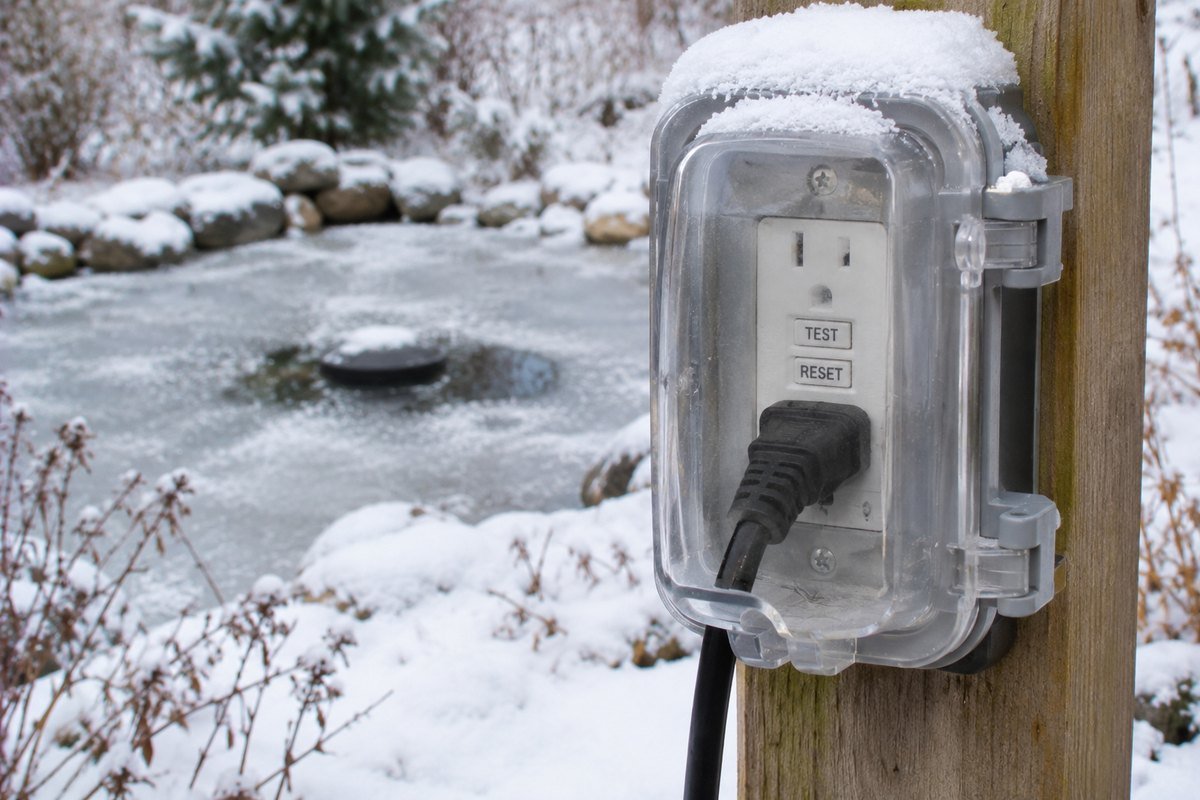
- Plug into a GFCI outlet. Aquascape's manual says to use an outlet with a ground-fault circuit interrupter (GFCI), and the Electrical Safety Foundation International also advises GFCI protection for outdoor electric lights and decorations. K&H and Aquascape both say not to use an extension cord.
- Raise the air stone. If you run an air pump in winter, Aquascape says to set the aerator on a shelf, not on the bottom, and to keep it near the de-icer but not stacked on it. This leaves the warmer water near the floor undisturbed. Our pond aeration guide covers winter air in more detail.
- Shut down the waterfall. In cold areas, Aquascape recommends turning off and removing the pump. If you keep it running, watch for ice dams that can push water out of the pond.
- Check it after storms. Brush heavy snow off the ice near the hole so light can reach the water.
Caring for Fish Over the Winter
- Depth matters. The Pond Guy says a pond should be at least 18 inches deep to overwinter hardy fish, since ponds can freeze 18 to 24 inches deep in cold areas. Purdue University says fish can overwinter in Indiana ponds deeper than 2.5 feet. The farther north you live, the deeper your pond should be.
- Feed less as it cools. Fish slow down in cold water. Purdue advises cutting back on feeding when the water stays below 50 degrees Fahrenheit. The Koi Club of San Diego recommends no feeding under 50 degrees and an easy-to-digest wheat germ food between 50 and 65 degrees.
- Use a pond thermometer. Feeding advice is based on water temperature, not air temperature, so check the water itself.
- Leave the fish alone. Fish rest near the bottom in winter. Avoid netting or moving them until spring.
For more on which fish handle cold best, see our pond fish guide.
Common Winter Pond Mistakes
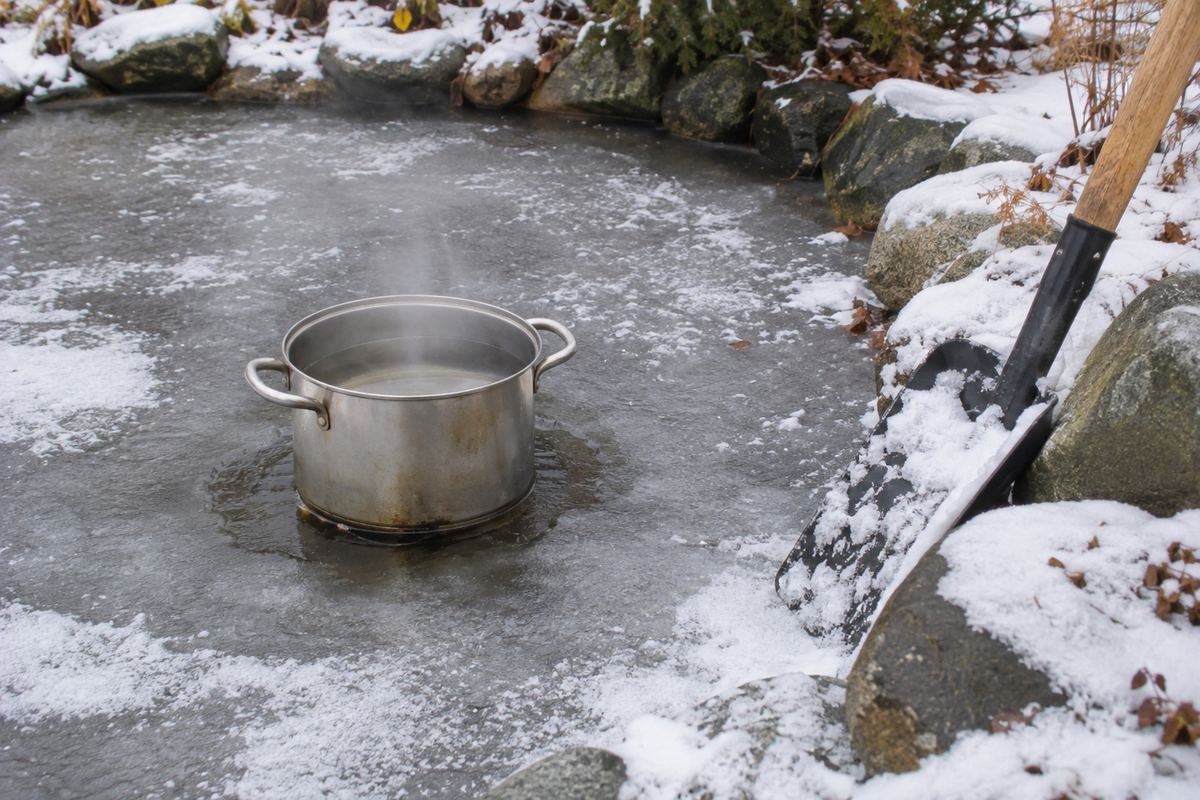
- Breaking the ice with a hammer or shovel. Aquascape warns that the shock waves can harm fish, and The Pond Guy says the pounding can stress them. If the pond freezes over, The Pond Guy suggests setting a pot of hot water on the ice to melt a hole.
- Buying a pond heater when you need a de-icer. A de-icer keeps a hole open for much less power.
- Letting a de-icer run dry. If the water level drops, the heating part can sit out of the water. K&H says its Deluxe de-icers must stay in water at all times.
- Using an extension cord. Plug straight into a GFCI outlet, as the makers advise.
- Leaving the air stone on the bottom. Move it up to a shelf for the winter.
- Ignoring mineral buildup. K&H warns that scale on the heating part can stop the de-icer or trip the GFCI. Wipe it clean when you check the pond.
Quick Answers
Do I need a pond heater or a de-icer?
Most backyard ponds need a de-icer, not a heater. A de-icer keeps a small hole open in the ice so gases can escape. A true pond heater warms all the water and uses far more power, so it is mainly for koi keepers who want warmer water all winter.
What size pond de-icer do I need?
It depends on your pond size and your USDA zone. On the K&H chart, a 250-watt de-icer covers ponds up to 100 gallons in every zone it lists, up to 750 gallons in zone 6, and up to 1,000 gallons in zones 7 and 8. Colder zones and bigger ponds call for 750 or 1,500 watts.
How much does it cost to run a pond de-icer?
Multiply the watts by the hours it runs, divide by 1,000, and multiply by your price per kWh. At about 18 cents per kWh, a 250 watt de-icer running all day costs about $1.08 a day. A thermostat lowers that because it only runs when needed.
Should I break the ice on my pond?
No. Aquascape warns that hitting the ice sends shock waves that can harm fish. If the pond freezes over, set a pot of hot water on the ice to melt a hole, then add a de-icer.
Can I leave my pond pump running in winter?
In cold areas, Aquascape says to turn off and remove the pump and its check valve. If you keep a waterfall running, watch for ice dams that can push water out of the pond. An air pump can keep running if you move the air stone up to a shelf.
Should I feed my fish in winter?
Feed less as the water cools. Purdue University advises cutting back once the water stays below 50 degrees Fahrenheit, and the Koi Club of San Diego recommends no feeding below 50 degrees. Our koi food guide has a full feeding chart by water temperature.
Where to Go Next
Preparing your pond for cold weather? Start with our seasonal pond care guide, then read the pond aeration guide to see how air helps fish all year. If you are planning a new pond, our how to build a pond guide covers depth for cold climates.