
The best pond fish for most backyard ponds are common goldfish, comets, and shubunkins. They are cheap, colorful, hardy enough to spend winter under ice, and stay small enough for a pond of a few hundred gallons. Koi are the other favorite, but they grow to about 18 inches or more. They need a bigger and deeper pond, usually 1,000 gallons or more. Whatever you choose, plan by adult size, not the size you buy, and add fish a few at a time.
This guide compares fish that do well in backyard ponds. It has a free calculator that shows how many your pond can hold. It also covers depth, feeding, winter care, and predators.
Table of Contents
Quick Answer: The Best Fish by Pond Size
- Under 500 gallons: up to about six common goldfish, comets, or shubunkins. Skip koi.
- 500 to 1,000 gallons: any hardy goldfish. Koi can work near the top of this range if the pond is deep and well filtered, but most keepers wait for about 1,000 gallons.
- Over 1,000 gallons: koi, or koi mixed with comets and shubunkins. Golden orfe need a big pond and a group.
- Skip: fancy goldfish in mixed ponds, tropical fish, plecos, sterlets in small ponds, and any fish your state restricts.
Pond Fish Stocking Calculator
Do not know your gallons? Our pond calculator works it out from length, width, and depth.
Pond Fish Stocking Calculator
Enter your pond size and pick the fish. The calculator gives a number of adult fish your pond can hold, and checks if the pond is deep enough for winter.
The Best Fish for a Backyard Pond
These are the fish most often kept in backyard ponds in the US. Sizes are typical adult sizes. Fish in a big pond with good food often grow larger.
| Fish | Typical adult size | Pond size | Winters under ice? | Good to know |
|---|---|---|---|---|
| Common goldfish and comets | About 6 to 12 in | A few hundred gallons and up | Yes | The easiest pond fish. Comets have a long, flowing tail. |
| Shubunkin and sarasa | About 6 to 12 in, sometimes more | A few hundred gallons and up | Yes | Goldfish with calico (shubunkin) or red-and-white (sarasa) colors. |
| Koi | About 18 in or more | About 1,000 gallons and up | Yes, with depth | Long-lived. They dig in plant pots and eat plants. |
| Golden orfe | Up to about 30 in | Large ponds | Yes | Fast swimmers that need a group and lots of oxygen. Some states restrict them, so check your state rules first. |
| Golden tench | Up to about 30 in | Large ponds | Yes | Shy bottom feeders. Check your state rules first. |
| Fancy goldfish | About 6 to 8 in | Goldfish-only ponds | Less hardy | Slow swimmers that lose out to comets and koi at feeding time. Often better kept indoors. |
Common goldfish and comets
Goldfish with a normal body shape are the classic pond fish. Oklahoma State University’s water garden fact sheet lists common goldfish, shubunkin, comet, and fantail as the best choices. It says fancy goldfish are not well suited to outdoor ponds because predators catch them more easily. Goldfish can spend winter in a pond that freezes over, as long as it does not freeze solid. The U.S. Fish and Wildlife Service puts their typical lifespan at 6 to 7 years, with reports of up to 30.
Shubunkins and sarasas
These are goldfish with different colors. Shubunkins have a calico pattern of blue, red, white, and black. Sarasas are red and white. Both are as tough as comets and mix well with them.
Koi
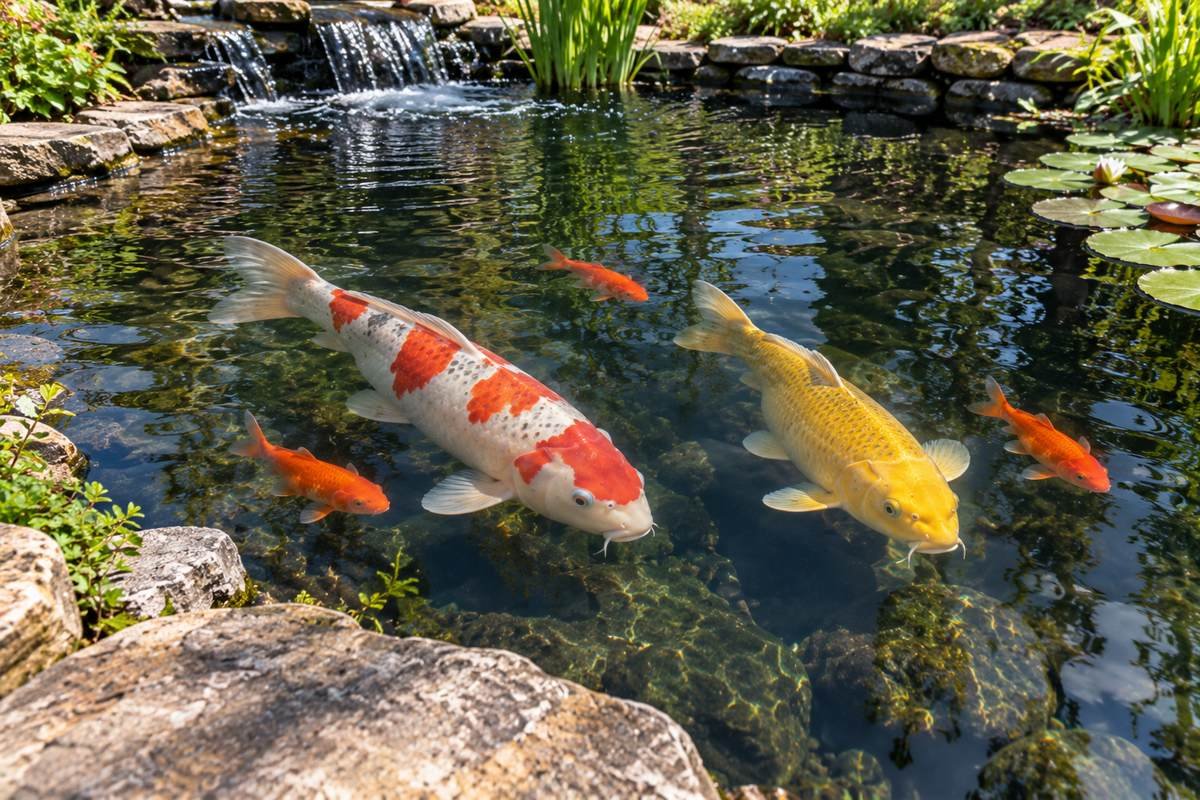
Koi are a fancy form of the common carp. The Oklahoma State fact sheet says the average adult koi is about 18 inches long and can live for decades. Their size is the catch. They make a lot of waste, they dig up plant pots, and Kansas State Research and Extension notes that koi often eat plants. Plan on a pond of about 1,000 gallons or more, a strong filter, and a deep area for winter.
Golden orfe and golden tench
Golden orfe are bright orange fish that swim in groups near the surface. The Ornamental Aquatic Trade Association recommends keeping them in groups of four or five. It says orfe, tench, and koi can grow to about 75 cm (30 inches). Tench are calm bottom feeders that stay out of sight much of the time. Both belong in large ponds.
Koi vs Goldfish
| Goldfish (common, comet, shubunkin) | Koi | |
|---|---|---|
| Adult size | About 6 to 12 in, sometimes more | About 18 in or more |
| Pond size | A few hundred gallons and up | About 1,000 gallons and up |
| Plants | Mostly leave plants alone | Dig in pots and eat plants |
| Filtration | A normal pond filter | A large filter for the extra waste |
| Winter depth | At least 18 to 24 in, more in cold areas | Deeper is better, often 3 ft or more |
| Can they live together? | Yes | Yes, with comets and shubunkins. Keep fancy goldfish apart. |
For a small or planted pond, goldfish are the better pick. For a large pond built around the fish, koi are the classic choice.
How Many Fish Can a Pond Hold?
Sources don’t agree on a single number. It depends on the filter, the aeration (an air pump, fountain, or waterfall that adds oxygen), and how big the fish grow. Common rules of thumb include:
- About 1 inch of adult fish per 10 gallons of water. Pond builders often quote this rule. Use half that for a lightly stocked pond that is easier to manage.
- About 250 to 500 gallons per adult koi.
- Texas AgriLife Extension’s water garden FAQ works by surface area instead. It suggests less than 2 inches of fish per square foot without aeration, and 4 to 6 inches with it.
The calculator above uses the gallon rules, counts adult size, and drops to the lower number if you have no aeration. Fewer fish means clearer water, less work, and healthier fish. The Ornamental Aquatic Trade Association also warns against adding too many fish at once. Add a few, wait a few weeks, and test the water before adding more.
How Deep Should a Fish Pond Be?
Fish need water that doesn’t freeze solid in winter or get too hot in summer. Advice varies by climate:
| Where you live | Deepest spot | Notes |
|---|---|---|
| Warm South, mild winters | 18 to 24 in | The Oklahoma State fact sheet says this is enough in the Deep South if only a few fish are stocked. |
| Cold winters with ice | At least 24 in, deeper is safer | Kansas State suggests a deep area of 24 to 30 inches for fish to spend the winter. Keep a hole open in the ice. |
| Very cold areas or koi ponds | 3 to 4 ft or more | The Oklahoma State fact sheet notes that many year-round ponds have a 3- to 4-foot-deep area that does not freeze. |
| Shallow or above-ground ponds | Under 18 in | Bring fish indoors for winter. |
How to Add Fish to a New Pond
- Remove chlorine. Treat tap water with a dechlorinator, a water conditioner sold at pet and pond stores, before adding fish. Many cities use chloramine, a mix of chlorine and ammonia. If yours does, pick a conditioner that says it treats chloramine.
- Let the pond settle. Texas AgriLife Extension says to wait 2 to 3 weeks for the natural filter bacteria to start before you add fish. Test for ammonia and nitrite with a pond water test kit. Both come from fish waste and are toxic to fish. Both should read zero. Test a week or two again after each new batch of fish.
- Keep new fish apart first. This is called quarantine. Oklahoma State’s low-management water garden fact sheet suggests holding new fish in a separate tank for at least two weeks, or 30 days for koi. This keeps disease from entering the pond.
- Float the bag. Float the closed bag in the shade for 10 to 15 minutes so the temperatures match. Then add a little pond water to the bag.
- Net the fish out. Lift the fish out with a net and leave the store water in the bag.
- Start small. Add a few fish, then wait a few weeks before adding more. Goldfish breed in ponds, so plan to give away extras each year.
Feeding Pond Fish by Water Temperature
Pond fish are cold-blooded, so how much they eat depends on the water temperature. Check it with a pond thermometer, not the air.
| Water temperature | What to do |
|---|---|
| Above about 60 F | Feed a normal pond food once or twice a day. |
| About 50 to 60 F | Switch to a cold-water (wheat germ) food and feed less. |
| Below about 50 F | Stop feeding. Kansas State says to stop feeding below 50 F. Start again in spring when the water stays above 50 F. |
| Above about 90 F | Feed less, since warm water holds less oxygen. |
Give only what the fish clean up in about 5 minutes, and scoop out food they leave. Extra food rots and feeds algae. A lightly stocked pond with plants can need little or no feeding at all. For how much to feed in grams and which foods to use, see our koi food guide.
Winter Care for Pond Fish
- Keep a hole in the ice. A solid ice cover traps gases from rotting leaves. Iowa State University Extension says a one foot opening per 100 square feet of pond surface is enough. A floating de-icer (a small heater) or a bubbler (an air pump with an air stone) keeps it open.
- Never hit the ice. Kansas State warns against breaking ice by hitting it. The shock can harm fish.
- Clear out leaves in fall. Rotting leaves use up oxygen under the ice. See our seasonal pond care guide.
- Stop feeding. Fish rest near the bottom in cold water and do not need food.
Moving water matters all year. A pump, waterfall, or air pump keeps oxygen up, especially on hot nights. Our pond aeration guide covers the options.
Keeping Herons and Raccoons Away

Herons and raccoons are the most common fish thieves. Penn State Extension says a net stretched 6 to 12 inches above the water is one of the most successful fixes. Other steps that help:
- Steep sides and a deep area, so a wading heron cannot reach the fish.
- A fish cave, such as a short section of wide pipe on the bottom, where fish can hide.
- A motion-activated sprinkler near the pond edge.
Great blue herons are protected by the federal Migratory Bird Treaty Act. The Michigan DNR notes that killing one is not allowed without a federal permit. Stick to nets and deterrents. The Tennessee Wildlife Resources Agency recommends a net over the pond, a depth of more than 3 feet, and a motion-activated sprinkler.
Fish to Avoid and Never Release
- Tropical fish and plecos. Guppies, mollies, and plecos (suckermouth catfish) cannot survive a northern winter. A U.S. Geological Survey study found the Orinoco sailfin catfish, a common pleco, died at about 4 C (about 39 F), the most cold-tolerant fish in the study.
- Sterlets and other sturgeon in small ponds. They are river fish that can reach 3 feet or more and need a lot of oxygen. The Ornamental Aquatic Trade Association suggests ponds of about 10,000 liters (about 2,600 gallons) for adult sturgeon.
- Mosquitofish without checking the rules. Some states limit where you can stock or release them. Check with your state wildlife agency first.
- Game fish such as bass and catfish. They belong in farm ponds and will eat your other fish.
Never release pond fish into a lake, stream, or storm drain. The U.S. Fish and Wildlife Service rates goldfish as a high-risk invasive species in the contiguous U.S. The Minnesota DNR says releasing unwanted fish is illegal. If you need to rehome fish, give them to another pond keeper, a pond club, or a local store.
Pond Fish Questions
What fish can live in a backyard pond year round?
Common goldfish, comets, shubunkins, and koi can live outdoors year-round in most of the US. The pond must be deep enough not to freeze solid, with a hole kept open in the ice.
How many goldfish can I put in a 500 gallon pond?
About 3 to 6 adult goldfish, assuming fish grow to about 8 inches. Use the lower number if you have no aeration.
Can koi and goldfish live together?
Yes. Koi live well with comets and shubunkins. Fancy goldfish are slower and are better kept in a goldfish-only pond.
How deep does a pond need to be for fish to survive winter?
About 18 to 24 inches in mild climates. In places where ponds freeze over, aim for at least 24 inches, and deeper for koi.
When should I stop feeding pond fish?
Switch to a cold-water (wheat germ) food when the water drops below about 60 F, and stop feeding below about 50 F. Start again in spring when the water stays above 50 F.
Do pond fish need a filter?
A lightly stocked pond with plenty of plants can get by with little filtration. Most fish ponds need a filter and moving water to stay clear and keep oxygen up.
Where to Go Next
Keep the water clear for your fish with our guides to pond filters, green pond water, and pond plants. Planning a new pond for fish? Start with how to build a pond.